Vinyl Plank vs Hardwood Stairs in Calgary: Cost, Installation and Which Is Better
If you are replacing carpet on your stairs in Calgary, two common options are vinyl plank and hardwood. Flooring Experts Calgary installs both.
Short answer: we charge $40 to $80 per step for vinyl plank and $80 to $150 per step for hardwood. On a 13-step staircase, that comes to $520 to $1,040 for vinyl and $1,040 to $1,950 for hardwood, before GST, landings or repairs.
Both can look good and hold up well, but they are not interchangeable. The better choice depends on the condition of the existing stairs, the finish you want, how much maintenance you are willing to do, and your budget.
There is also an important point that gets missed in a lot of stair flooring comparisons: the material is only part of the job. Stairs require proper nosing, accurate fitting, and a finished surface that does not create a trip hazard. The existing stair construction can also change the cost significantly.
Here is how the two options compare.
Calgary Stair Flooring Costs
Stair projects are difficult to price accurately from a simple per-square-foot flooring rate. A stair has treads, risers, edges and nosing, and every tread requires individual fitting.
We price stairs per step:
| Project | Price per step | 13-step staircase |
|---|---|---|
| Vinyl plank stairs | $40 to $80 | $520 to $1,040 |
| Hardwood stairs | $80 to $150 | $1,040 to $1,950 |
| Custom staircases | $150 to $250 | $1,950 to $3,250 |
| Refinishing existing hardwood stairs | Priced after inspection | Depends on the wood’s thickness and condition |
Add 5% GST if a quote does not already include it. Actual pricing can be higher or lower depending on the existing stairs, number of steps, material selected, demolition, nosing details, risers, landings, winders, and the amount of preparation required.
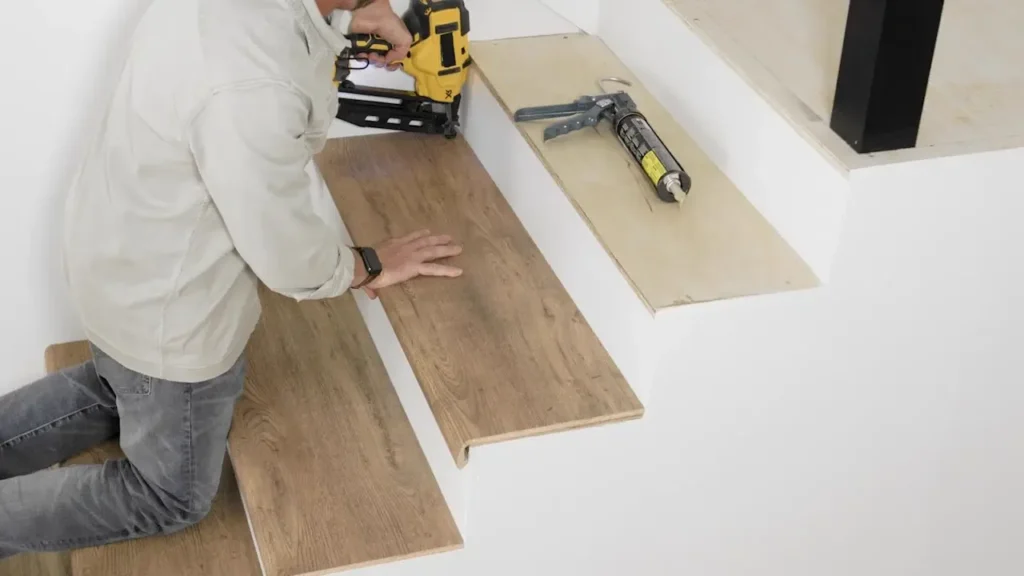
Why stair pricing varies so much
Two staircases with the same number of steps can require very different amounts of work.
For example, one staircase may have:
- Carpet that can be removed without major substrate repairs
- Straight, standard-size treads
- Closed risers
- No damaged framing
- A straightforward stair nosing solution
Another may have:
- Several layers of flooring
- Uneven or damaged plywood
- Existing hardwood that needs to be removed
- Winders or unusual tread shapes
- Open sides
- A landing that also needs to be finished
- Existing treads that are too thin or uneven for a simple cap-over installation
That is why a contractor should inspect the stairs before giving a firm price.
It is also worth asking what a quoted price includes. “Per step” can mean very different things depending on the contractor. One quote may include only the tread material, while another may include demolition, risers, nosing, installation, finishing and cleanup.
Vinyl Plank on Stairs
Vinyl plank is popular because it gives you a durable, relatively low-maintenance surface and can be matched to vinyl flooring used elsewhere in the home.
But stair installation is different from installing vinyl plank on a flat floor.
A proper stair installation may involve:
- Removing the existing carpet or flooring
- Inspecting the underlying treads and risers
- Repairing or replacing unsuitable substrate
- Measuring each tread individually
- Installing the stair tread and riser material
- Installing an appropriate stair nosing or stair-edge system
- Checking the finished dimensions and transitions
- Completing the landing or other connected areas where required
The exact installation method depends on the vinyl product.
Not every click-lock vinyl plank is automatically suitable for use on stairs. Some manufacturers specify particular adhesive methods, stair nosings, or installation details. The product’s installation instructions should be checked before it is used on a staircase.
Advantages of vinyl stairs
Vinyl can make sense if you want:
- Easy day-to-day cleaning
- Good resistance to everyday spills
- A consistent appearance
- A lower-maintenance surface than finished wood
- A similar floor throughout the main living areas
- A practical option for busy households
Vinyl is also available in wood-look designs, so you can get the appearance of hardwood without using solid wood on every stair component.
What to watch for
A common mistake is treating stair installation like a normal floating-floor installation.
A stair needs a secure finished surface and a properly designed edge. The nosing is particularly important because it is the part of the tread that every step lands on.
The installation also needs to maintain consistent stair geometry. Adding material to an existing tread can change the finished dimensions, so the contractor should account for the thickness of the new system rather than simply covering the old surface.
Hardwood Stairs
Hardwood remains a strong choice if you want the stairs to be a major visual feature of the home.
It can also make sense when the rest of the main floor already uses hardwood and you want the staircase to look like part of the same flooring system.
There are several ways to approach a hardwood stair project.
Refinishing existing hardwood
If the existing stairs are solid hardwood and have enough usable material remaining, refinishing may be the least disruptive option.
The process generally involves:
- Removing the existing finish
- Sanding the wood
- Repairing suitable damaged areas
- Staining if required
- Applying a new protective finish
Whether refinishing is practical depends on the actual thickness and condition of the existing wood.
Repeated sanding can eventually leave a floor or stair tread with insufficient material for another full refinish. Engineered wood also needs to be assessed differently from solid hardwood.
Re-cladding existing stairs
Another option is to install new hardwood components over the existing stair structure.
This can work well when the underlying stairs are structurally sound but the visible surface is dated or unsuitable.
The installer needs to account for the additional material thickness so the finished stair dimensions remain appropriate.
Replacing the treads
If the existing treads are damaged, unsuitable, or too uneven for a cap-over installation, replacement may be necessary.
This is generally more involved than simply installing a new surface over the existing tread, but it can produce a cleaner result when the underlying stairs need substantial work.
Prefinished vs. Site-Finished Hardwood
If you choose hardwood, you also have to decide how you want it finished.
Prefinished hardwood
The finish is applied at the factory.
Advantages include:
- Consistent factory finish
- Faster installation
- No on-site staining process
- Less disruption during the project
Site-finished hardwood
The wood is installed and then sanded, stained and finished at the property.
This takes longer, but it gives you more control over the final colour and can make it easier to match existing hardwood.
If matching an existing floor is important, ask the contractor whether they recommend prefinished material or site finishing. The answer depends on the existing wood species, colour, age and finish.
Calgary Climate and Stair Flooring
Calgary’s climate is another factor, but it is worth being precise about why.
Wood responds primarily to changes in moisture content and indoor relative humidity. Calgary’s dry winters can create conditions in which wood loses moisture, while seasonal humidity changes can cause wood to gain moisture.
That can contribute to:
- Gaps between boards
- Seasonal movement
- Changes in appearance
- Finish-related issues
Good installation practices and reasonable indoor humidity control help reduce these problems.
Vinyl does not respond to indoor humidity in the same way as wood, which is one reason it can be attractive to homeowners who want a lower-maintenance surface.
However, vinyl is not a solution to every moisture problem. Water can still get underneath flooring if there are leaks, poor transitions, or installation problems.
It is also important to distinguish between water-resistant flooring and a waterproof stair assembly. Installing a water-resistant material does not make the entire staircase waterproof.
Durability: Vinyl vs. Hardwood
Both materials can last for years when properly installed, but they age differently.
| Factor | Vinyl | Hardwood |
|---|---|---|
| Everyday cleaning | Easy | Easy, with appropriate products |
| Water resistance | Generally better | More sensitive to moisture |
| Scratches | Can scratch or scuff | Can scratch or dent |
| Refinishing | Generally not refinished | Can often be refinished |
| Appearance | Wood-look options | Natural wood |
| Long-term repair | Damaged pieces may need replacement | Can sometimes be repaired or refinished |
| Maintenance | Generally lower | More maintenance over its life |
The right choice depends on what kind of wear you expect.
A household with pets, children, heavy foot traffic or frequent outdoor footwear may put more emphasis on easy cleaning and resistance to everyday spills.
Someone renovating an older home or trying to create a high-end hardwood staircase may place more value on natural wood and the ability to refinish it later.
Stair Safety Matters More Than the Flooring Material
A stair can look excellent and still have an installation problem if the finished dimensions are not properly considered.
The important factors include:
- Consistent riser heights
- Consistent tread depths
- Proper nosing
- Secure installation
- Appropriate transitions
- Adequate traction
- Correct treatment of landings and winders
This matters particularly when installing a new surface over an existing stair.
Adding a new tread system changes the finished thickness of the step. If the installation is not planned correctly, the finished staircase can end up with inconsistent dimensions.
For a renovation in Alberta, the applicable building requirements should also be considered. A qualified contractor should account for the requirements that apply to the specific staircase rather than treating the project as a simple flooring installation.
What Is Under the Carpet?
If your stairs are currently carpeted, do not assume you know what is underneath until the carpet is removed.
The existing structure could include:
- Solid hardwood
- Softwood or construction-grade wood
- Plywood
- OSB
- Composite or engineered stair components
- Previously installed flooring
- A combination of materials from earlier renovations
This matters because the right installation method depends heavily on the substrate.
For example, sound existing hardwood may be a good candidate for refinishing. A structurally sound but unattractive staircase may work well for re-cladding. Damaged or unsuitable material may need to be removed or repaired first.
This is a key reason an accurate stair quote normally requires an on-site assessment.
Which Option Makes More Sense?
To decide, start with the condition of the staircase rather than the flooring material.
| Your situation | Option worth considering |
|---|---|
| You want low maintenance | Vinyl |
| You want natural wood | Hardwood |
| Existing hardwood is in good condition | Refinishing |
| Existing stairs are sound but unattractive | Hardwood or vinyl re-cladding |
| You want the stairs to match existing hardwood | Hardwood |
| You want a wood-look finish with easier maintenance | Vinyl |
| Existing treads are damaged or unsuitable | Replacement may be required |
| You are renovating on a tighter budget | Compare vinyl with refinishing before replacing everything |
There is no universal winner.
The condition of the existing stairs can matter more than the difference between vinyl and hardwood.
Matching the Stairs to the Rest of the House
A staircase usually connects multiple areas of the home, so the flooring choice should be considered alongside the floors at the top and bottom of the stairs.
If you already have hardwood on the main floor, matching the species, stain and finish can make the staircase look intentional.
If the main floor uses vinyl plank, continuing a similar colour and pattern onto the stairs can create a more consistent appearance.
An exact match is not always possible, especially when existing flooring has aged or the original product is no longer available.
In that situation, it is usually better to aim for a coordinated colour and finish than to force a nearly identical match that still looks different.
Questions to Ask Before Hiring a Stair Flooring Contractor
Before accepting a quote, ask:
- What exactly is included in the price?
- Does the price include removal of the existing carpet or flooring?
- Will the existing treads be inspected before installation?
- What happens if damaged substrate is found?
- Are risers included?
- Is the stair nosing included?
- How will the new material be secured to the stairs?
- Is the proposed vinyl product approved by its manufacturer for stair installation?
- Does the price include the landing?
- How will the new flooring transition into the floors above and below?
- If hardwood is being refinished, is there enough material for another sanding?
- Will the finished stair dimensions be checked after installation?
- What warranty applies to the materials and installation?
These questions make it much easier to compare two quotes that appear different on paper.
Vinyl vs. Hardwood: Which Should You Choose?
Choose vinyl if your priorities are low maintenance, easy cleaning, consistent appearance and a practical wood-look finish.
Choose hardwood if your priorities are natural wood, a higher-end appearance, compatibility with existing hardwood and the ability to refinish the surface later.
If you already have hardwood stairs under the carpet, do not automatically assume replacement is necessary. Refinishing may give you a better result for less work.
If the existing stairs are structurally sound but the visible surfaces are outdated, re-cladding may be worth considering.
And if the underlying staircase is damaged or unsuitable, the project may require more than simply choosing between vinyl and hardwood.
What the Project Costs
The per-step rates and 13-step totals are in the price table at the top of this guide. Refinishing existing hardwood stairs is priced after the contractor checks the wood’s thickness and condition.
A contractor should confirm the actual price after inspecting the stairs and determining exactly what work is required.
A low quote is not automatically a useful one. It is the one that clearly explains what is being installed, what preparation is included, how the stair nosing will be handled, and what happens if problems are discovered underneath the existing flooring.
Frequently Asked Questions
Is vinyl or hardwood better for stairs?
Neither is automatically better. Vinyl is generally the more practical choice for homeowners prioritizing low maintenance and easy cleaning. Hardwood is a better fit when natural wood appearance, refinishing and integration with existing hardwood are more important.
Can vinyl plank be installed on stairs?
Some vinyl products can be used on stairs, but the installation method depends on the specific product. Always check the manufacturer’s stair-installation requirements and use the appropriate stair nosing or edge system.
Is hardwood more expensive than vinyl on stairs?
Usually. Our per-step rate for hardwood is higher than for vinyl plank (see the table at the top), and hardwood costs climb further when new treads, custom fitting, staining or site finishing are involved. The difference depends heavily on the existing staircase and the scope of the work.
Can carpeted stairs be converted to hardwood?
Yes, in many cases. The carpet is removed first and the underlying staircase is assessed. Depending on its condition, the existing structure may be refinished, re-clad or rebuilt with new treads.
Can you refinish hardwood stairs?
Often, yes. The existing wood needs enough usable thickness and must be in suitable condition for sanding. A contractor should inspect the stairs before recommending refinishing.
How long do vinyl stairs last?
The lifespan depends on the product, installation quality and amount of traffic. Manufacturer specifications are the place to check expected product performance. Heavy stair traffic can also produce different wear than a flat residential floor.
Do hardwood stairs require more maintenance?
Generally, yes. Hardwood may need more care over its lifetime, particularly if the finish becomes worn or the wood is scratched. One advantage is that suitable hardwood can often be repaired or refinished rather than completely replaced.
Should I choose the same flooring on the stairs as the main floor?
Not necessarily, but coordinating the materials usually produces a more cohesive result. If the main floor is hardwood, matching hardwood stairs keeps the floor and stairs looking the same. If the main floor is vinyl, a compatible vinyl stair system may be more practical.
Final Takeaway
For Calgary homeowners replacing carpeted stairs, the decision should start with the condition of the existing staircase, not simply the price of the flooring material.
Vinyl is a practical choice when you want low maintenance and a durable wood-look surface.
Hardwood is worth considering when appearance, natural material and future refinishing are more important.
And if you already have good hardwood underneath the carpet, refinishing may be the option worth investigating first.
The right way to compare the choices is to have the staircase inspected, confirm exactly what each quote includes, and make sure the proposed installation maintains safe and consistent finished stair dimensions.