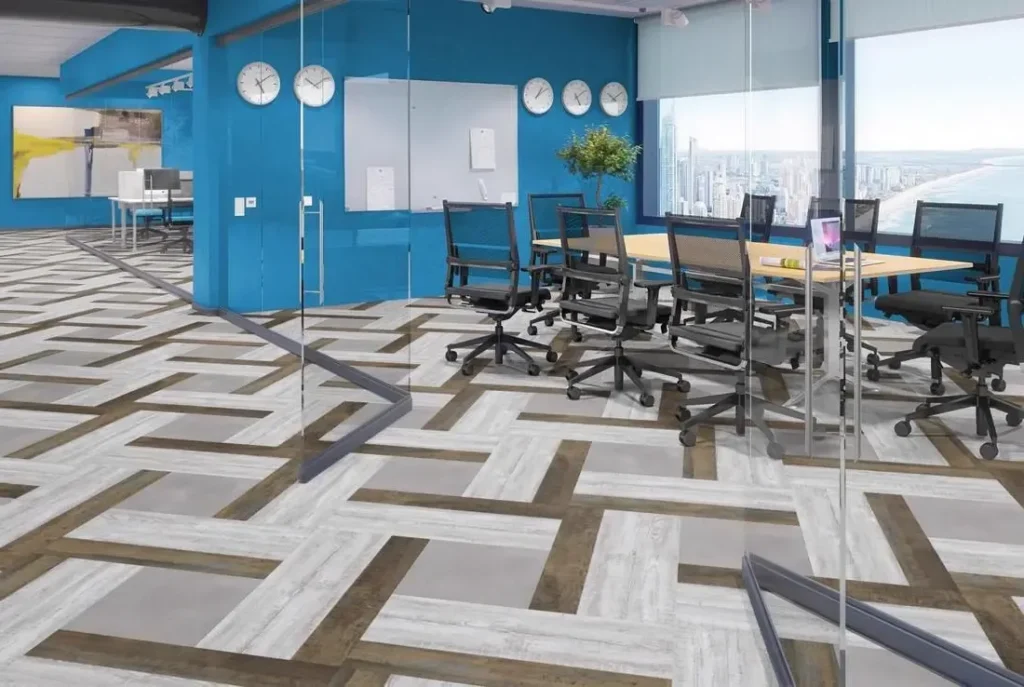
Carpet tile earns its place in a commercial building because it can be repaired one tile at a time. That only works if the layout, the adhesive and the attic stock are decided at the point of purchase.
Set out from a real layout, not the door
Adhesive matched to traffic and access floor
Spare stock quantified before ordering
Request a Carpet Tile Quote
Send the area or floor plan, the traffic pattern, whether there is an access floor, and the product range you are considering.
Dye lots vary between production runs. Ordering spare stock with the original batch is the only reliable way to match later.
Commercial carpet tile decisions that keep a floor replaceable
Carpet tile only delivers its main advantage if these are settled before the order is placed.
Laying pattern
Monolithic, quarter turn, ashlar or brick. The pattern changes how a replaced tile blends in, how waste is calculated and how tolerant the floor is of a slight shade variation.
Adhesive system
Releasable pressure-sensitive adhesive, tabs or a permanent adhesive. Releasable systems are what allow a single tile to be lifted years later without damaging its neighbours.
Dye lot and batch
Confirm the whole floor including spares comes from one production run. Later batches of the same product can read differently under office lighting.
Set-out point
Where the grid starts. Setting out from the room centre or a dominant sightline avoids thin slivers at the most visible wall.
Attic stock quantity
How many boxes are retained, where they are stored and who holds them. Spares kept on site in a dry, flat, labelled location are the ones that still get used.
Access floor allowance
If tiles sit on an access floor, confirm how panels are lifted for services afterwards and whether the tile grid aligns with the panel grid.
Commercial carpet tile cost ranges in Calgary, Canadian dollars
Researched planning ranges for early budgeting only, never a quote. Commercial specification products, phased work and after-hours labour sit above these figures.
Most popular
Carpet installation
$3-$8 per sq ft
Covers supply and install across a broad product range. Tile specification, pattern waste, floor plate complexity and access all move it.
Carpet tile in the entry lane wears first in a Calgary winter
Between November and April the first few metres inside a Calgary entrance take a punishing load. When road surfaces drop below -5C the City spreads pickle, a mix of 3 per cent salt and 97 per cent fine gravel, and that gravel arrives indoors on every boot. It is abrasive rather than corrosive, and it stays in the walked lane. In a modular floor that is manageable: run generous entrance matting, expect the entry and lift-lobby tiles to wear first, and hold enough attic stock to swap that lane out on its own. Replacing thirty tiles at a doorway is a maintenance task. Replacing a broadloom lobby is a project.
Flooring Experts Calgary installs commercial carpet tile across Calgary in offices, clinics, schools, common areas and multi-tenant buildings. Buildings specify modular tile so a damaged area can be replaced a tile at a time, and that depends on the adhesive system, the laying pattern and the attic stock ordered with the floor.
Commercial carpet tile and single-tile replacement
Broadloom fails as a whole floor. One chair castor tear, one coffee spill that will not come out, one flood from a mechanical room, and the repair is a visible patch or a new room. Carpet tile fails locally, and a local failure can be fixed locally.
Three conditions preserve that. The adhesive has to release. The pattern has to disguise a slight shade shift. The spares have to exist, in the right quantity, in a dry flat place someone can find. Miss any of those and you have paid a modular price for a floor that has to be replaced like broadloom.
Carpet tile also fits an operating building. It is installed and walked on zone by zone, it needs no stretching or power-stretching, it cuts efficiently around irregular floor plates, and the offcuts from one area are usable in the next.
Carpet tile adhesive, laying pattern and dye lot
Three specification decisions do most of the work.
The adhesive system is the first. Releasable pressure-sensitive adhesive is the usual choice for commercial tile, holding against traffic and rolling loads while still allowing a tile to be lifted intact. Tab systems and full permanent adhesives exist and each suits particular conditions, and the product data sheet, the traffic and whether there is an access floor underneath decide between them.
The laying pattern is the second. Monolithic gives the cleanest continuous appearance but is the least forgiving when one tile is swapped. Quarter turn rotates alternate tiles and hides directional shading, which is why so many offices use it. Ashlar and brick offsets stagger the joints and read more like a plank floor. Pattern also affects waste, so it changes the order quantity as well as the look.
The batch is the third and the one most often forgotten. Carpet tile is dyed in production runs, and two runs of the same product can read differently under office lighting. Order the floor and its spares together.
Preparation still applies. Tiles need a flat, clean, stable substrate, and old direct-glue broadloom leaves adhesive that has to be dealt with rather than covered. As Canadian-dollar planning ranges only, carpet work sits around $3-$8 per square foot, removal around $1-$3 and levelling around $2-$6 over the area treated.
Carpet tile attic stock and spare tile storage
Attic stock is the line in the order that makes a later repair possible. Decide the quantity from your realistic worst case rather than from what happens to be left over, which in practice means the entry, the lift lobby and the main circulation lane, since that is where a commercial floor wears out first.
Then store it properly. Boxes stay flat, dry and off a concrete floor, labelled with the product name, colour, batch and the date and area installed. Tell facilities where they are. Carpet tile stored upright against a wall in a damp room takes a permanent curl and will not lay flat when it is needed.
Commercial carpet tile questions in Calgary
How much attic stock should we keep?
There is no single figure, but it should be decided deliberately rather than left to leftovers. Base it on the size of your worst-case replacement area, usually the entry and the main circulation lane, and order it with the original run so it matches.
What is the difference between quarter turn and monolithic laying?
Monolithic runs every tile in the same direction for a continuous look. Quarter turn rotates alternate tiles ninety degrees, which breaks up directional shading and makes a replaced tile far less obvious later. Ashlar and brick patterns offset the rows.
Can carpet tile go over the existing broadloom?
No. The old floor comes up. Carpet tile relies on a stable, flat, clean substrate to stay put, and laying it over a soft, uneven backing causes edges to lift and tiles to creep.
Why does releasable adhesive matter?
It holds the tile firmly against traffic but allows a single tile to be lifted later without tearing its neighbours or the substrate. That is the entire reason a building specifies modular tile instead of broadloom.
Will a replacement tile match in five years?
If it came from the same production run and has been stored flat and dry, closely. If it is ordered new, expect some shade difference, because dye lots vary and the installed floor will have aged. A quarter-turn layout hides that far better than a monolithic one.
Can it be installed in stages while staff are working?
Yes. Modular tile is well suited to it, because each zone can be cleared, installed and walked on without waiting for a whole floor to be completed.
Decide carpet tile layout, adhesive and attic stock together
Send the floor plan, the traffic pattern and the product range you are looking at.
To provide the best experiences, we use technologies like cookies to store and/or access device information. Consenting to these technologies will allow us to process data such as browsing behaviour or unique IDs on this site. Not consenting or withdrawing consent, may adversely affect certain features and functions.
Functional
Always active
The technical storage or access is strictly necessary for the legitimate purpose of enabling the use of a specific service explicitly requested by the subscriber or user, or for the sole purpose of carrying out the transmission of a communication over an electronic communications network.
Preferences
The technical storage or access is necessary for the legitimate purpose of storing preferences that are not requested by the subscriber or user.
Statistics
The technical storage or access that is used exclusively for statistical purposes.The technical storage or access that is used exclusively for anonymous statistical purposes. Without a subpoena, voluntary compliance on the part of your Internet Service Provider, or additional records from a third party, information stored or retrieved for this purpose alone cannot usually be used to identify you.
Marketing
The technical storage or access is required to create user profiles to send advertising, or to track the user on a website or across several websites for similar marketing purposes.