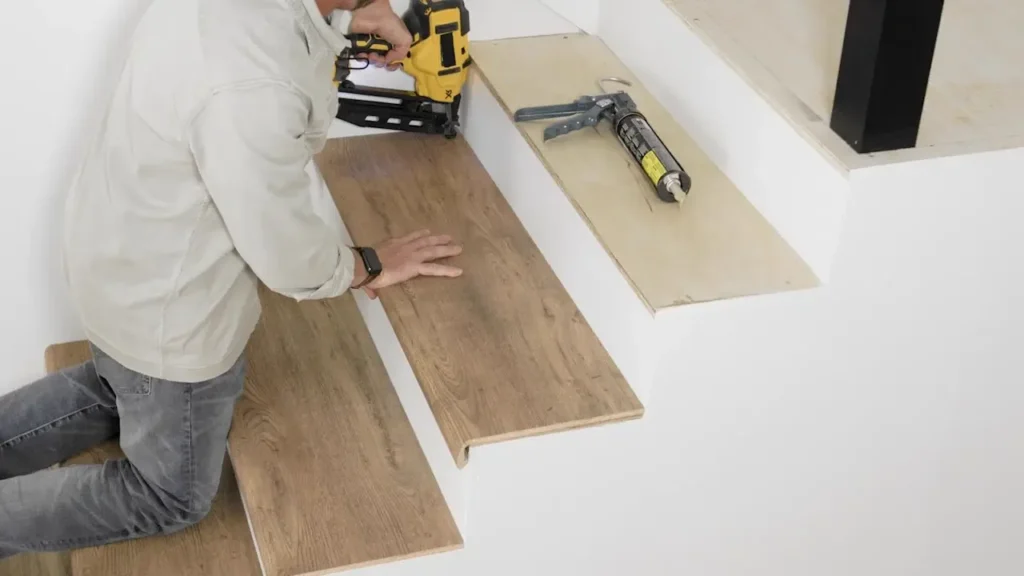
Existing wood keptSanded in placeMasking and cure planned
Stair Refinishing Calgary for Existing Wood Stairs
Stair refinishing is priced per flight from the step count, set by whether the railing is done too and how much hand work the nosings and spindle bases need. When the wood is already there and worth keeping, refinishing brings it back without replacing a single tread. The awkward parts are the corners a machine cannot reach, the railing that has to be protected, and the days the flight is out of use.
Hand work at nosings and corners
Railing and spindles masked
Return-to-use sequence agreed
Request a Stair Refinishing Quote
Send photos of the worn areas, the number of steps, whether there is a railing with spindles, and the current finish if you know it.
Existing wood is assessed for remaining thickness and previous coatings before refinishing is confirmed as the right approach.
Our Process
How stair refinishing runs in a Calgary home
1
Assess the existing wood
Check remaining thickness above the fasteners, previous coatings, deep damage and whether any tread is beyond sanding.
2
Mask and contain
Wrap the handrail, spindles and newel posts, protect the landings and seal the working area from the rest of the house.
3
Sand and detail
Machine-sand the open tread faces, then work the nosings, spindle bases and inside corners by hand where no machine fits.
4
Coat and cure
Apply stain if it is changing, then build the finish coats with the drying interval the product requires between them.
Where these stairs come from
Stair refinishing in Calgary's bungalow ring
Calgary’s 1960s to 1980s housing ring was built with solid wood stairs that were frequently carpeted afterwards, and the inner-city pre-1960 stock often has original flights too. Under decades of traffic or a layer of underlay, a lot of these treads still have enough material left to sand. That is the first thing we check, because it decides whether the answer is refinishing or replacement.
In placeTreads sanded without dismantling the flight
MaskedHandrail, spindles and newels wrapped
CureReturn to use set by the finish, not the clock
Per flightScoped by the staircase, not by floor area
We refinish existing wood stairs by sanding the treads in place instead of replacing the flight.
Stair refinishing depends on the wood left above the fasteners
Refinishing is only an option while there is material to remove. Every sanding takes a little thickness off the tread, and each tread was fixed with fasteners set at a certain depth. Once sanding would expose them, that tread is finished as a sanding candidate.
So the assessment comes first. We look at how many previous finishes are present, whether anyone has sanded before, how deep the traffic wear runs on the middle of each step, and whether damage is surface level or structural. Splits, deep gouges and cupped treads are called out individually. It is normal to refinish a whole flight and replace one or two problem steps, and it is better to price that at the start than to discover it on day two.
Calgary's housing stock helps here. The 1960s to 1980s bungalow ring was built with solid stairs that were often carpeted afterwards, and the pre-1960 inner-city stock frequently has original flights. Under the underlay there is usually more wood left than the homeowner expects.
Stair refinishing around the railing and spindles
The handrail, newel posts and spindles are the reason stair refinishing takes longer per square metre than floor refinishing. A drum sander cannot get near them.
The railing assembly gets wrapped and masked before any sanding starts, then the sanding is done in two passes of a kind: machine work across the open faces of the treads, and hand work at the nosings, the inside corners, the wall string and the base of every spindle. On a flight with fifteen steps and thirty balusters, that hand detail is a meaningful part of the day.
Whether the railing itself is being refinished is decided at the quote stage. Doing it in the same visit is efficient. Doing it later means masking a freshly finished stair all over again.
Containment matters too, because a staircase usually sits in the middle of a house rather than in a closed room. The working area gets sealed off from the rooms around it, and the sanders run with vacuum extraction. That reduces dust considerably. It does not eliminate it.
Stair refinishing cure time and getting upstairs meanwhile
The part people underestimate is not the sanding. It is the waiting.
Finish coats need a drying interval between them and a longer period before the surface takes normal traffic. On a floor you can walk around the room. On a staircase there is often no way around at all, and a house with one flight has a genuine logistics problem for the duration.
We plan that explicitly. Before the job is booked we set out how many coats the chosen product needs, what the interval is between them, and which steps are usable at which point. Some households move what they need downstairs for a couple of days. Some schedule the work while they are away. Either works, provided the coat sequence is set before the first coat goes on.
Calgary's winter adds two wrinkles. Ventilation is harder when opening a window means dropping the house temperature, and forced-air heating pushes dust around the building at the worst possible moment. Chinooks can also swing conditions noticeably between one coat and the next. None of that stops winter refinishing, and plenty of it happens here, but it does mean coats are scheduled around the heating cycle rather than around convenience.
Stair refinishing questions in Calgary
Can my stairs be sanded, or are they too far gone?
It comes down to how much wood sits above the fasteners and how deep the damage goes. Surface scratches, dulled finish and traffic wear sand out readily. Splits, deep gouges and treads already sanded several times may need replacing instead, and that is a per-tread decision.
Do the spindles and handrail have to come off?
Usually not. They are wrapped and masked, and the wood around their bases is worked by hand. Removing balusters is possible but it turns a refinishing job into a carpentry job, and it is rarely worth it just for sanding access.
Can the railing be refinished at the same time?
It can, and it is worth deciding at the quote stage rather than midway. Railings are hand-sanded and coated separately from the treads, and doing them later means masking the new tread finish all over again.
How dusty is stair sanding?
Less than it used to be. Our sanders run with vacuum extraction and the working area is sealed off, but stair refinishing involves hand sanding in corners no extraction reaches, so it is not a dust-free process.
Can we still use the stairs while the finish cures?
That is the question to settle before booking. Some households can stay off a flight for the required period, and some have no second staircase at all. Where there is only one route upstairs, we plan the sequence around that and set out what the finish product allows.
Is winter a bad time to refinish stairs in Calgary?
It is workable but it needs planning. Ventilation is harder when it is cold, forced-air heating moves dust around, and a chinook can shift indoor conditions during cure. We schedule coats around the heating cycle rather than pretending the season makes no difference.
How much does refinishing cost?
Stairs are priced per flight from the step count, with the railing as a separate line if it is refinished too. Our $3 to $7 per square foot rate covers floor refinishing, not stairs. We charge based on your written quote.
Related flooring services
Carpet to Hardwood Stairs in Calgary
Converting carpet stairs to hardwood in Calgary: treads, risers, nosings, open and closed stringers. Send photos of the flight for a scoped estimate.
Hardwood floor refinishing in Calgary: full sanding, stain and finish, or a screen and recoat. We check your boards can take a sanding first. Free quote.
To provide the best experiences, we use technologies like cookies to store and/or access device information. Consenting to these technologies will allow us to process data such as browsing behaviour or unique IDs on this site. Not consenting or withdrawing consent, may adversely affect certain features and functions.
Functional
Always active
The technical storage or access is strictly necessary for the legitimate purpose of enabling the use of a specific service explicitly requested by the subscriber or user, or for the sole purpose of carrying out the transmission of a communication over an electronic communications network.
Preferences
The technical storage or access is necessary for the legitimate purpose of storing preferences that are not requested by the subscriber or user.
Statistics
The technical storage or access that is used exclusively for statistical purposes.The technical storage or access that is used exclusively for anonymous statistical purposes. Without a subpoena, voluntary compliance on the part of your Internet Service Provider, or additional records from a third party, information stored or retrieved for this purpose alone cannot usually be used to identify you.
Marketing
The technical storage or access is required to create user profiles to send advertising, or to track the user on a website or across several websites for similar marketing purposes.