Diamond Valley service areaBlack Diamond and Turner ValleyEntries and main floors
Flooring in Diamond Valley, Alberta
In a foothills house the entry and the traffic lane that runs off it wear out years before the rest of the floor. Our installed rates are $6-$12 per sq ft for vinyl plank and $8-$25 for tile (CAD), with levelling at $2-$6 per sq ft where the base needs it; a small entry prices toward the top of the tile range. That is the part of the specification worth arguing about, and it usually comes down to the wear layer rather than the colour.
Wear layer chosen for the room, not the catalogue
Entry treated separately from the main floor
Thresholds planned for meltwater
Request a Diamond Valley Flooring Quote
Tell us which rooms are involved, what is on the floor now, and how the entry is used through the winter.
Product suitability follows the room and the substrate. Measurements are needed before any figure becomes a quote.
Surfaces that hold up in a working entry
Porcelain tile
The hardest wearing option at a door and indifferent to melting snow. It needs a rigid, flat, compatible base underneath, and it stays cold underfoot unless heat is built into the assembly.
Rigid-core vinyl plank
Warmer and quieter than tile and tolerant of water. Ask for the wear layer thickness in mil rather than the product's marketing name, because that number is what decides how it copes with grit.
Somewhere for the grit to stop
A matted or recessed catch area inside the door does more for the life of a floor than any product upgrade. Grit that never reaches the plank cannot abrade it.
Diamond Valley project
Rigid core vinyl plank for entries and bathrooms
In a foothills house the first metre inside the door does most of the ageing, because the winter gravel that comes in on boots works like an abrasive. Rigid core vinyl plank, chosen by wear layer rather than colour, handles that grit, and because water does not swell the plank, the same floor works in the bathroom.
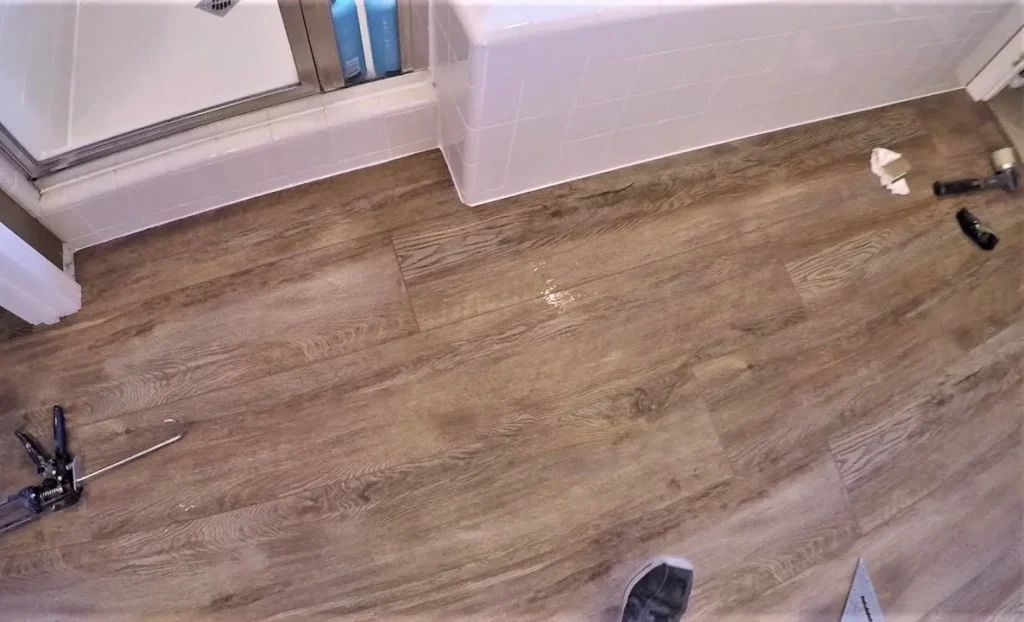
The plank runs from the door to where the traffic lane ends, and in a bathroom the expansion gap at the tub is sealed with silicone. A long mat goes inside the door so most of the grit stops there.
Pictured: our Diamond Valley project – brown wood-look vinyl plank laid in a bathroom up to the tub, with tools still on the floor.
Our rates in Canadian dollars. We charge based on your written quote, which depends on measurements, preparation and the product chosen.
Most popular
Vinyl and LVP installation
$6 to $12 per sq ft
Our rate for vinyl and luxury vinyl plank. Wear layer thickness, rigid versus flexible core and the amount of subfloor preparation set your final price.
Diamond Valley is the town formed in 2023 when Black Diamond and Turner Valley merged, so we take work in both, under either name.
The first metre inside the door does most of the ageing
Walk any foothills house in March and the floor tells you where people come in. The finish is dulled in a band inside the door, there is a scuff line where boots pivot, and everything beyond that looks close to new.
That is abrasion, not wear in any general sense. Winter traction material in this region is gravel-based rather than salt-based, because salt loses its usefulness as the road gets colder. The fine gravel comes indoors on boots and acts like a sheet of abrasive under every footstep. It is the honest reason an entry and a traffic lane need a harder surface here than the same rooms would need in a milder, wetter place.
The practical response is not to buy a tougher floor for the whole house. It is to buy the tougher floor for the ten square metres that take the punishment, and to give the grit somewhere to stop before it gets any further.
Freeze-thaw at the threshold, not in the middle of the room
Diamond Valley is a foothills community in chinook country, where warm spells and hard overnight freezes alternate through the winter.
For a floor, the interesting consequence is at the door. Snow arrives on boots, melts on a warm surface, then refreezes on the step outside or in the joint at the threshold when the temperature drops back overnight. Repeated enough times, that cycle finds every place water can sit. A threshold that sheds or drains, a surface that does not mind standing water and perimeter joints filled with a flexible sealant rather than grout are all cheap decisions at specification and expensive ones later.
Reading a specification instead of a product name
Most flooring is sold on the picture. The parts that determine how long it lasts are further down the sheet.
On vinyl and luxury vinyl plank, ask for the wear layer thickness in mil. That single figure tells you more about the entry than the collection name does. On tile, the question is the substrate: how flat it is, how stiff it is and whether the setting materials are specified as a compatible system rather than assembled from whatever was on the shelf.
On any product, ask what the manufacturer requires for subfloor flatness and moisture, because that requirement is what a warranty claim is measured against, and it is also the thing most likely to add a levelling line to your quote.
Entry flooring questions in Diamond Valley
What wears an entry floor out?
Grit, mostly. Fine gravel from winter roads and driveways comes in on boots and behaves like sandpaper underfoot. It is abrasion rather than water that dulls a finish and cuts through a wear layer in the first metre inside the door.
Is a thicker wear layer worth paying for?
In an entry or a traffic lane, yes. On vinyl and LVP the wear layer is measured in mil and it is the part of the product that faces the grit. In a bedroom the difference is largely theoretical. Spending the upgrade where the traffic is, rather than across the whole house, is usually the better call.
Should the entry use a different material from the rest of the main floor?
Often it should, and the interesting question is where the change happens. A material change reads as deliberate when it lands at a doorway, a cabinet run or a genuine change of room, and reads as a mistake when it stops in the middle of open floor.
Does a foothills house need anything different for freeze-thaw?
The place it shows up is the threshold. Snow comes in, melts, and refreezes at the door or on an unheated step outside. That argues for a surface that tolerates standing water, a threshold detail that drains or sheds rather than trapping it, and sealant joints that stay flexible.
Can heated floor go under an entry tile?
We install the flooring side of that work, meaning the mat or cable set into the assembly, the extra build-up height it needs and the tile over the top. The electrical connection is a licensed electrician's work and not something we carry out.
Flooring services for this area
Vinyl and Luxury Vinyl Plank Flooring in Calgary
Vinyl plank flooring installed across Calgary: rigid core LVP for basements, kitchens and entries, with the subfloor levelled first. Get a free written quote.
Tile installation in Calgary for floors, bathrooms, entries and heated floors. Substrate, membrane and layout planned before the first tile. Free quote.
To provide the best experiences, we use technologies like cookies to store and/or access device information. Consenting to these technologies will allow us to process data such as browsing behaviour or unique IDs on this site. Not consenting or withdrawing consent, may adversely affect certain features and functions.
Functional
Always active
The technical storage or access is strictly necessary for the legitimate purpose of enabling the use of a specific service explicitly requested by the subscriber or user, or for the sole purpose of carrying out the transmission of a communication over an electronic communications network.
Preferences
The technical storage or access is necessary for the legitimate purpose of storing preferences that are not requested by the subscriber or user.
Statistics
The technical storage or access that is used exclusively for statistical purposes.The technical storage or access that is used exclusively for anonymous statistical purposes. Without a subpoena, voluntary compliance on the part of your Internet Service Provider, or additional records from a third party, information stored or retrieved for this purpose alone cannot usually be used to identify you.
Marketing
The technical storage or access is required to create user profiles to send advertising, or to track the user on a website or across several websites for similar marketing purposes.