Ceramic and porcelainThinset and mortar bedsContained demolition
Tile removal in Calgary homes
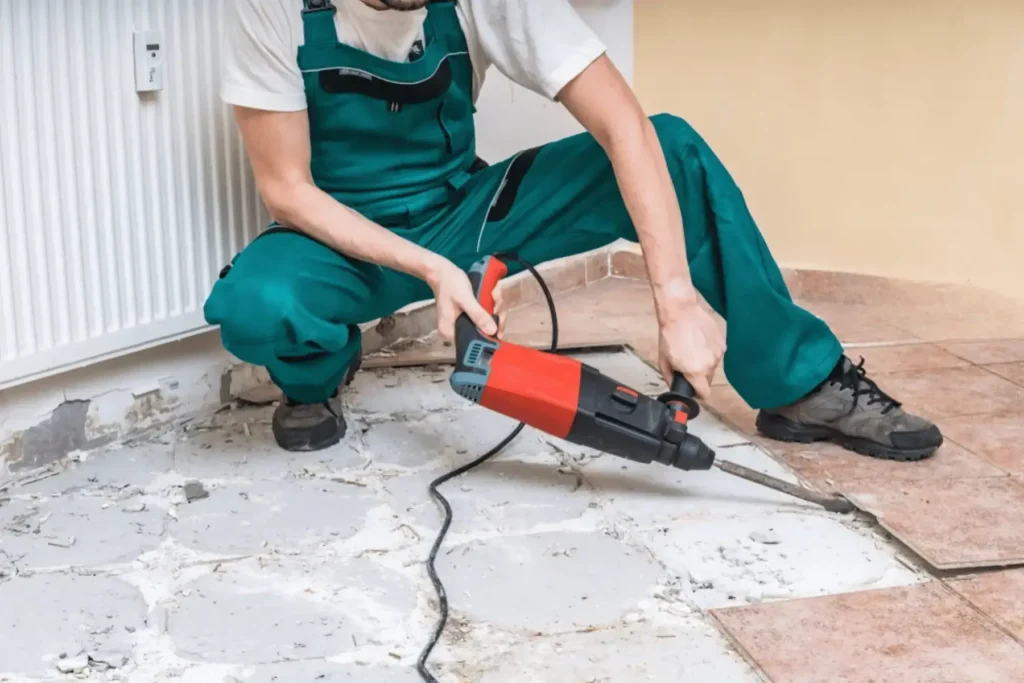
Removal costs $1-$3 per sq ft, set by what the tile is set over, the bond strength and the containment the room needs, with a thick mortar bed quoted as its own line. Tile does not lift. It is broken out, and so is the setting material bonded to whatever sits below it. The substrate you are left with is the real outcome of the job, so we plan for it before the first tile is cracked.
Setting method identified first
Substrate protected where possible
Demolition dust contained
Request a Tile Removal Quote
Send the room, approximate square footage, tile size and what you believe the tile was set over.
If we suspect asbestos-containing material, we stop work in that area and leave it undisturbed. In Alberta, asbestos removal is done by workers who hold a provincial asbestos worker certificate. We do not sample and we do not perform abatement.
Five things that set tile removal pricing in Calgary
Two tiled rooms of identical size can be very different jobs. These are the variables that decide which one you have.
What the tile is set over
Cement backer board, a thick mortar bed, plywood or a concrete slab each produce a different demolition method and a different amount of substrate repair.
Setting material and bond strength
Modern thinset over a rigid backer releases differently from a bed poured over wire lath. Bond strength decides whether tile chips off or takes the substrate with it.
Tile size and body
Porcelain fractures rather than crumbles, and large-format units come away in heavy sharp pieces. Both change handling, protection and debris weight.
Containment and site protection
Tile demolition is the dustiest flooring work there is. Sealed openings, protected routes and a chosen dust-control method are part of the scope, not an extra.
Suspect material protocol
If material we suspect may contain asbestos is uncovered, we stop work in that area and hand the question to an asbestos abatement contractor before anything else happens.
Tile removal over backer board, mortar bed and slab
Over cement backer board
Tile, thinset and board often come out together as one system. The work shifts to fasteners and screw holes, and the substrate below usually survives in reasonable shape.
Over a poured mortar bed
Common in older bathrooms. The bed is thick, heavy and reinforced with lath. Removing it is slow, produces serious debris weight and drops the finished height significantly.
Bonded directly to slab or plywood
The hardest case. Thinset bonded straight to the substrate means the substrate takes the damage, and gouged plywood or a scarred slab needs preparation before anything new goes down.
After the tile is off
The substrate left behind after tile removal
A tile removal is finished when the base is sound, clean and flat enough to build on, not when the last tile hits the bin. Ridged thinset, torn plywood veneer, exposed lath fixings and a slab scarred by scraping all have to be dealt with before the next floor is ordered. We photograph and describe that condition rather than covering it over, because it determines whether the next step is a skim coat, a levelling pour or panel replacement.
Flooring Experts Calgary carries out tile removal in Calgary, taking up ceramic, porcelain and stone tile together with the thinset or mortar bed it is bonded to.
What tile removal involves in a Calgary home
Carpet is pulled. Laminate is unclicked. Tile is broken. Every tiled floor is a bonded assembly, and the bond is usually stronger than the parts around it, which means the setting material decides where the failure happens. If the thinset is holding better than the plywood veneer beneath it, the plywood is what comes away.
Tile removal is therefore planned from the setting system rather than from the tile. The debris is heavy and sharp instead of bulky and soft. The dust is fine, mineral and persistent, so containment is planned before demolition rather than improvised during it. And the finished height changes, sometimes by a noticeable amount, which affects door swings, thresholds and the transition into any adjoining room.
Tile removal from backer board, mortar bed and concrete slab
Three setting systems cover most Calgary tile. Tile over cement backer board is the cooperative one, because tile, thinset and board frequently come out together and the work becomes fasteners and screw holes. Tile over a poured mortar bed, common in older bathrooms, is slow and heavy: a reinforced bed with wire lath comes out in weighty sections and takes a real amount of finished height with it. Tile bonded straight to slab or plywood is the difficult one, because there is no sacrificial layer, so the substrate absorbs the damage.
Once the floor is open, the slab gets its own look. Expansive clay soils are widespread across Alberta including Calgary, and clay movement affects basement floor slabs to a much greater degree than footings, so heaved and cracked slabs are far more common in this city than foundation damage. If a basement tile floor cracked in a consistent line, the slab under it is the thing to assess before choosing what goes down next, because a new floor over a moving base repeats the same failure. Our page on slab heave and levelling explains that step.
Asbestos and pre-1990 tile removal in Calgary
Vinyl-asbestos tile and asbestos-containing sheet flooring and adhesives were used in North American housing built before roughly 1990, and Calgary's pre-1960 inner-city stock and its 1960s to 1980s bungalow ring both fall inside that window. Tile removal is exactly the activity that disturbs it.
If we uncover material that we suspect may contain asbestos, we stop work in that area, leave it undisturbed and tell you immediately and in writing. Testing belongs with a qualified asbestos consultant, and handling and removal in Alberta belong with workers who hold a provincial asbestos worker certificate. We do not sample it ourselves and we do not perform abatement. The job resumes when a qualified abatement contractor has cleared the area.
That stop-work boundary sits in the agreed scope before demolition begins, and abatement is contracted separately with an asbestos abatement contractor rather than added to the tile removal price.
Tile removal cost in Calgary
Tile removal is priced at the demanding end of our floor removal rate of $1 to $3 per square foot in Canadian dollars. Heavy mortar-bed demolition, where a reinforced bed comes out in weighty sections, can cost more than the top of that rate. We charge based on your written quote. See our Calgary flooring rates for the other services.
Whatever the substrate needs afterwards is priced separately once it is exposed, because ridged thinset, torn plywood veneer and a scarred slab each call for a different correction: a skim coat, a levelling pour or panel replacement. Our rate for levelling work in Calgary is $2 to $6 per square foot.
Tile removal questions in Calgary
Can tile be removed without damaging the substrate?
Sometimes, but it is not something to promise in advance. Tile set over backer board usually comes away cleanly with the board. Tile bonded directly to plywood or slab almost always leaves ridged residue or surface damage that needs preparation afterwards.
Can new tile go straight over the old tile instead?
It is occasionally possible, but it raises the finished height, loads the existing assembly and hides whatever condition the original substrate is in. If the plan is a long-lived floor, removal gives you a base you can verify.
How much mess does tile demolition make?
A great deal, and the dust is fine enough to travel. Sealed openings, covered routes and an agreed dust-control method are part of the scope, along with the point at which debris leaves the building.
My basement tile is cracked in a straight line. Does that change removal?
It may change what happens next. Once the tile is off, the slab should be assessed on its own before a new floor is selected.
What happens if you find something that might contain asbestos?
We stop work in that area, leave the material undisturbed and tell you in writing what we have found. Sampling is done by a qualified asbestos consultant, and removal in Alberta is done by workers who hold a provincial asbestos worker certificate. We do not sample and we do not perform abatement, and the job resumes once an asbestos abatement contractor has cleared the area.
What does tile removal cost in Calgary?
Our rate for removal across all floor types is $1 to $3 per square foot in Canadian dollars. Tile sits at the demanding end of that rate, and a thick mortar bed over wire lath is quoted as its own line.
Related flooring services
Floor Removal in Calgary
Floor removal in Calgary: tear-out of carpet, laminate, vinyl and hardwood, adhesive residue, dust control and bin logistics. Send room details for a quote.
Tile installation in Calgary for floors, bathrooms, entries and heated floors. Substrate, membrane and layout planned before the first tile. Free quote.
Tell us the room, the tile size and roughly when the house was built. We will explain the likely setting method and what the substrate is likely to need.
To provide the best experiences, we use technologies like cookies to store and/or access device information. Consenting to these technologies will allow us to process data such as browsing behaviour or unique IDs on this site. Not consenting or withdrawing consent, may adversely affect certain features and functions.
Functional
Always active
The technical storage or access is strictly necessary for the legitimate purpose of enabling the use of a specific service explicitly requested by the subscriber or user, or for the sole purpose of carrying out the transmission of a communication over an electronic communications network.
Preferences
The technical storage or access is necessary for the legitimate purpose of storing preferences that are not requested by the subscriber or user.
Statistics
The technical storage or access that is used exclusively for statistical purposes.The technical storage or access that is used exclusively for anonymous statistical purposes. Without a subpoena, voluntary compliance on the part of your Internet Service Provider, or additional records from a third party, information stored or retrieved for this purpose alone cannot usually be used to identify you.
Marketing
The technical storage or access is required to create user profiles to send advertising, or to track the user on a website or across several websites for similar marketing purposes.