Plywood and OSB panelsSqueak eliminationRot and delamination
Subfloor repair Calgary: panels, fasteners, squeaks and rot
Repairs are priced by the area opened, set by how many panels are replaced, whether blocking is added and whether the covering has to come up, with any levelling to match the surrounding floor at $2-$6 per sq ft. The subfloor is the layer nobody sees and everybody hears. We open it up where it needs opening, replace panels that are soft, swollen or delaminated, and refasten the sections that have simply worked loose over the years.
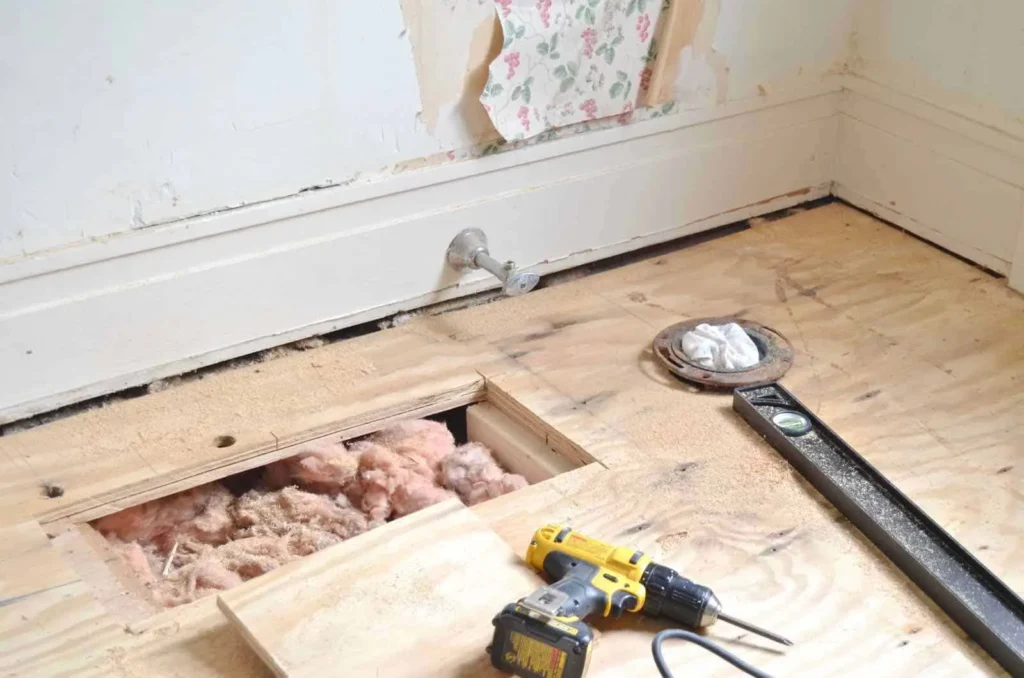
Cut out and replace failed panels
Refasten loose sheathing to joists
Report anything structural rather than hide it
Request a Subfloor Repair Quote
Tell us where the movement or noise is, what the finished floor is now, and whether there has been a leak.
Subfloor condition can only be confirmed with the covering off. Any work that becomes structural is called out separately.
Three failures behind most Calgary subfloor repairs
Loose fastening
A sharp repeating squeak in the same spot that moves with your weight. The panel is riding up and down the shank of a nail that is no longer gripping. Refastening into the joist resolves most of these.
Unsupported panel edges
A deeper knock or drum sound near a seam. Panel edges that fall between joists with no blocking or tongue-and-groove engagement flex independently and load the finish above unevenly.
Moisture damage
A soft, spongy area, sometimes with staining or a swollen seam. Water-affected OSB and plywood lose strength permanently. Once a panel has delaminated it is replaced, not dried out and reused.
Moisture damage
Cut back to bearing, not patched over
A failed section is opened up to the centre of a joist on each side so the new panel has something solid to land on, with blocking added where a cut edge falls in open space. The replacement matches the existing thickness, so no ridge or hollow shows under a thin covering.
Our Process
How a Calgary subfloor repair is carried out
1
Map the movement
Walk the floor and mark every squeak, soft spot and deflection so the work is targeted rather than exploratory.
2
Open only what is needed
Lift the covering over the marked areas, expose the sheathing and confirm joist spacing, direction and panel condition.
3
Replace and refasten
Cut out failed sections back to bearing, add blocking where edges are unsupported, install matching-thickness panel and fasten to the framing.
4
Re-check flatness
Verify the repaired area against the surrounding floor and feather or level any step before the finish goes back down.
Flooring Experts Calgary carries out subfloor repair in Calgary on plywood and OSB sheathing, replacing failed panels, refastening loose ones and eliminating squeaks before a new floor goes down.
Subfloor repair by panel replacement in plywood and OSB
Sheathing panels fail in a small number of predictable ways: they get wet, they lose their fastening, or their edges were never properly supported. Replacement is the answer to the first of those and sometimes the third.
A proper panel replacement is cut back to bearing. The failed section is opened up to the centre of a joist on each side so the new material has something solid to land on, and blocking is added where a cut edge falls in open space. The replacement panel matches the existing thickness, because a difference of even a few millimetres becomes a visible ridge or a hollow under a thin covering. It is fastened into framing on a proper schedule, not tacked at the corners.
Overlaying a soft spot with a thin sheet does not resolve it. Compromised sheathing keeps deflecting under the overlay, the fasteners holding the overlay work loose against a substrate that is no longer sound, and the same complaint comes back with an extra layer on top of it.
Subfloor repair that stops squeaks in a Calgary floor
A squeak is almost always friction between two components moving relative to each other. In practice that means one of three things: a panel riding up and down on a nail shank, two panel edges rubbing at an unsupported seam, or the sheathing shifting against the top of a joist.
Diagnosis comes before repair. We walk the floor and mark each noise, because the source is often a short distance from where you hear it, and because a floor with four discrete squeaks needs four targeted repairs rather than a whole-room rebuild. Where an unfinished basement ceiling gives access from below, a good deal can be resolved from that side with blocking and shims, without disturbing the finished floor at all. Where the ceiling is finished, the covering over that area generally has to come up.
Screws into framing, rather than more nails, are the usual permanent fix. Adhesive between sheathing and joist helps where the gap is being closed for the first time. What does not work is fastening into the space between joists, which simply adds a new pivot point.
Subfloor repair after rot, delamination and Calgary's dry winters
Two Calgary conditions show up in subfloor work more than anything else.
The first is water, which is not subtle. A dishwasher line, a failed toilet seal, a basement backup or a hail-driven leak leaves swollen edges, staining and a spongy underfoot feel. Wet OSB in particular swells at the seams and does not return to its original thickness when it dries, so the ridge stays even after the moisture is gone. Delaminated plywood, where the plies have separated, has permanently lost the structural behaviour it was specified for. Both get replaced.
The second is dryness, which is subtle and specific to this city. Calgary sits in the chinook belt, and heated indoor relative humidity through the winter routinely falls well below 30 per cent, under the 30 to 50 per cent range Health Canada recommends for homes. Wood shrinks in those conditions, and we explain the same effect on finished boards under hardwood and Calgary's dry winters. Fasteners that were holding adequately stop holding, small gaps open at panel joints, and floors that were silent in August start talking in January. That is a real seasonal pattern, and it is worth knowing that a squeak which arrives with the heating season and eases in spring is usually a fastening issue rather than a failing floor.
Where the investigation points past the sheathing and into joists, bearing or framing, the work has left the scope of a subfloor repair. It sits under the National Building Code 2023 Alberta Edition, enforceable in Alberta since May 1 2024, and belongs with the trades and professionals qualified to sign off on it.
Subfloor repair questions in Calgary
Can floor squeaks be fixed without pulling up the finished floor?
Sometimes, if there is access from below through an unfinished basement ceiling, because shims and blocking can be worked in at the joist. Where the ceiling is finished and the noise is coming from the sheathing itself, the covering usually has to come up over that area.
Why did my floor start squeaking in winter?
Calgary's chinook winters dry out heated indoor air. Wood loses moisture and shrinks slightly in those conditions, fasteners that were marginal stop gripping, and the noise appears. It often quietens in summer and returns the next heating season.
Is OSB worse than plywood for a subfloor?
Both are standard sheathing and both perform when they stay dry. The difference shows after a water event: OSB tends to swell at the edges and does not recover its original thickness, so a wetted OSB seam often leaves a permanent ridge that has to be addressed before a thin covering goes over it.
Can you just screw down the loose boards and leave it?
Where the panel is sound and simply unfastened, yes, and that is the correct repair. Where the panel itself is soft, delaminated or swollen, screwing it down only fixes it in place while it continues to fail.
What if the problem turns out to be the joists, not the subfloor?
Then we say so and stop. Framing, bearing and structural repair belong with the appropriate trade or a qualified engineer. We will describe what we found rather than sheet over it.
Do you repair the subfloor before installing new flooring?
Yes, and it is quoted as its own item. Repair usually has to happen with the old covering off and before the new one is ordered, because the repaired area often needs feathering or levelling to match the surrounding floor.
Related flooring services
Floor Leveling in Calgary
Floor leveling in Calgary: flatness tolerance, levelling compound, feathering and heaved basement slabs. Send room details for a floor prep quote.
Water damage floor repair in Calgary after a leak or flood. Drying confirmed first, then an honest read on what survives and a documented flooring scope.
Basement subfloor in Calgary: dimpled membrane and panel systems over the slab, finished height, thermal break and moisture. Send your details for a quote.
To provide the best experiences, we use technologies like cookies to store and/or access device information. Consenting to these technologies will allow us to process data such as browsing behaviour or unique IDs on this site. Not consenting or withdrawing consent, may adversely affect certain features and functions.
Functional
Always active
The technical storage or access is strictly necessary for the legitimate purpose of enabling the use of a specific service explicitly requested by the subscriber or user, or for the sole purpose of carrying out the transmission of a communication over an electronic communications network.
Preferences
The technical storage or access is necessary for the legitimate purpose of storing preferences that are not requested by the subscriber or user.
Statistics
The technical storage or access that is used exclusively for statistical purposes.The technical storage or access that is used exclusively for anonymous statistical purposes. Without a subpoena, voluntary compliance on the part of your Internet Service Provider, or additional records from a third party, information stored or retrieved for this purpose alone cannot usually be used to identify you.
Marketing
The technical storage or access is required to create user profiles to send advertising, or to track the user on a website or across several websites for similar marketing purposes.