High River service areaOlder homes in parts of townWritten flooring scopes
Flooring in High River, Alberta
High River carries a documented flood history, and part of its housing is older stock. Our rates (CAD) are $1-$3 per sq ft for removal and $2-$6 per sq ft for levelling, then $6-$15 for hardwood or $6-$12 for vinyl plank. Subfloor replacement after water is priced line by line once readings are taken, and where a restoration contractor has dried the property we start once their final readings allow it. Both leave marks in a floor assembly that are invisible from standing height, so we look under the finish before we price anything.
Readings taken before rebuild
Subfloor opened where history warrants
Scope written line by line
Request a High River Flooring Quote
Tell us the rooms, the current floor, and any history of water in the property, including work that has already been done.
We are a flooring contractor. We do not perform restoration drying, we are not adjusters, and we hold no remediation certification.
What water leaves behind
The finish dries long before the assembly does
Plywood and OSB hold moisture well after the surface has returned to its normal colour, and a concrete slab that has taken water can keep releasing it for weeks. Underlay, insulation and any levelling compound below all behave the same way, and none of it can be judged by standing on the floor. Where a property has a water history, we take readings and write them down rather than working from how the floor feels underfoot.
The date, the source, how long it sat and what was done afterwards change the scope more than the room dimensions do.
2
Take readings, not impressions
Meters on the wood, and where a slab is involved and the new floor is moisture sensitive, an in-situ probe or calcium chloride test.
3
Open up where the history warrants it
Lift a section rather than spot-checking. What is under a floor that has taken water is the part that decides the real scope.
4
Write the scope in separate lines
Removal, disposal, subfloor work, levelling and new floor as individual items, with photographs taken before anything came up.
High River project
Replacing a floor after water damage
After a leak or a flood, the visible floor is the last thing that should be replaced. The subfloor or slab under it has to be dried and checked first, because plywood, OSB and concrete hold moisture long after the surface looks normal.
We remove the damaged flooring, test the moisture in what is underneath, replace any subfloor that has swollen or delaminated, and only then install the new floor. The scope is written down so an insurer or a future buyer can see what was done.
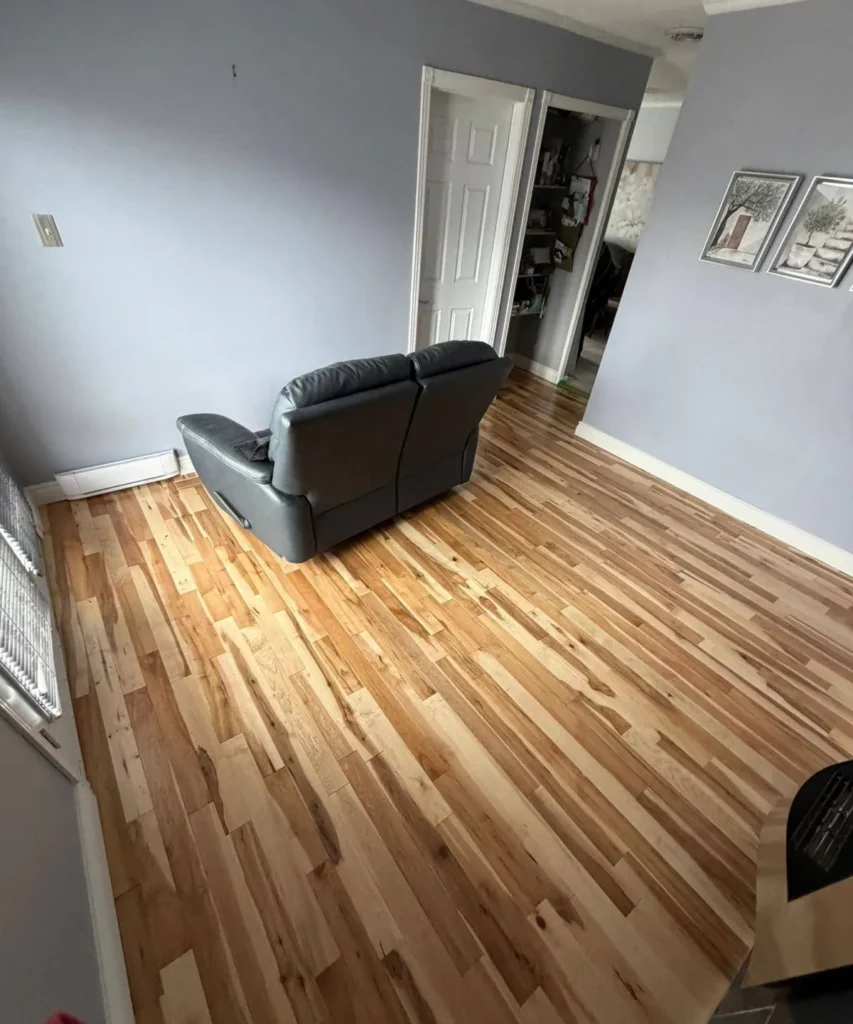
Pictured: our High River project – newly installed multi-tone hardwood in a living room with a grey recliner.
Water history is part of the floor's specification
The June 2013 southern Alberta flood reached High River, and that is not distant history for a floor. It changed what is under a lot of surfaces in this town, and it changed the sequence in which work was done, much of it in a hurry, some of it thoroughly, some of it not.
So when we look at a floor here, the first question is not what material you would like. It is what has happened to this assembly, when, and what was done about it afterwards. A replaced surface does not tell you the subfloor was replaced. It does not tell you a slab was tested, or that joists were checked, or that levelling compound placed over a damp base was ever allowed to dry properly.
What we do about that is take readings and write them down. Meters on wood. Where a slab is involved and the new floor is moisture sensitive, an in-situ probe or a calcium chloride test rather than a judgement. And where the history warrants it, we lift a section and look rather than spot-check from the edge of the room.
Older stock and what sits under the finish
The other half of the picture is age. Part of High River's housing predates the modern subfloor, which means plank boards rather than sheet goods underneath and, in many of those homes, several old layers on top.
If we find old vinyl tile that could contain asbestos, we stop work and tell you; abatement is done by certified workers, not by us.
Writing a scope somebody else can read
Where flooring work follows a water event or an insurance claim, the useful thing a flooring contractor produces is documentation, not opinion. That means room-by-room measurements, the floor types identified, photographs taken before anything is lifted, and a written breakdown that separates removal, disposal, subfloor work, levelling and the new floor into individual lines.
Be clear about what that is and is not. We are a flooring contractor. We are not adjusters, we do not run restoration drying equipment, and we hold no remediation certification. Where a restoration contractor has already been through the property, we want their final readings and the date the equipment came off, because that determines whether we can start or need to wait.
Waiting is often the right answer. A floor laid over a substrate that is still wet gives you cupping, adhesive failure and, below grade, a mould problem that costs a multiple of what the flooring did.
High River flooring questions
The flood was years ago and the floor was replaced. Does it still matter?
It is still worth mentioning. A replaced surface does not tell you what happened to the subfloor, the joists or a slab underneath, and remedial work done under time pressure is not always complete. Knowing the history tells us where to open up rather than guess.
Can old solid hardwood that cupped be saved?
Sometimes, and it is written off too quickly. Solid boards cup when they take moisture from below, and that is not automatically permanent; a floor that dries slowly and evenly often flattens over weeks or months, at which point sanding and refinishing restores it. Sanding while the boards are still damp is the mistake, because the crowns come off and those areas end up dished once the wood flattens.
What does not survive water?
Laminate is the clearest case. The core is fibreboard and once it has swollen at the edges the board is finished. Carpet underlay is effectively always replaced because it behaves like a sponge. Carpet itself can sometimes be saved if the water was clean and it was lifted quickly, but not where the water was contaminated.
Do you handle the insurance side?
No. We are a flooring contractor, not adjusters, and we do not perform restoration drying or hold remediation certification. What we produce is a flooring scope you can submit: room-by-room measurements, floor types identified, photographs taken before anything is lifted, and removal, disposal, subfloor work, levelling and new floor broken out as separate lines.
What is different about flooring an older High River home?
Mostly what is underneath: plank subfloors and old layers that need an overlay panel or levelling before a click floor goes down. Our subfloor repair page covers that preparation.
Flooring services for this area
Floor Leveling in Calgary
Floor leveling in Calgary: flatness tolerance, levelling compound, feathering and heaved basement slabs. Send room details for a floor prep quote.
Water damage floor repair in Calgary after a leak or flood. Drying confirmed first, then an honest read on what survives and a documented flooring scope.
To provide the best experiences, we use technologies like cookies to store and/or access device information. Consenting to these technologies will allow us to process data such as browsing behaviour or unique IDs on this site. Not consenting or withdrawing consent, may adversely affect certain features and functions.
Functional
Always active
The technical storage or access is strictly necessary for the legitimate purpose of enabling the use of a specific service explicitly requested by the subscriber or user, or for the sole purpose of carrying out the transmission of a communication over an electronic communications network.
Preferences
The technical storage or access is necessary for the legitimate purpose of storing preferences that are not requested by the subscriber or user.
Statistics
The technical storage or access that is used exclusively for statistical purposes.The technical storage or access that is used exclusively for anonymous statistical purposes. Without a subpoena, voluntary compliance on the part of your Internet Service Provider, or additional records from a third party, information stored or retrieved for this purpose alone cannot usually be used to identify you.
Marketing
The technical storage or access is required to create user profiles to send advertising, or to track the user on a website or across several websites for similar marketing purposes.