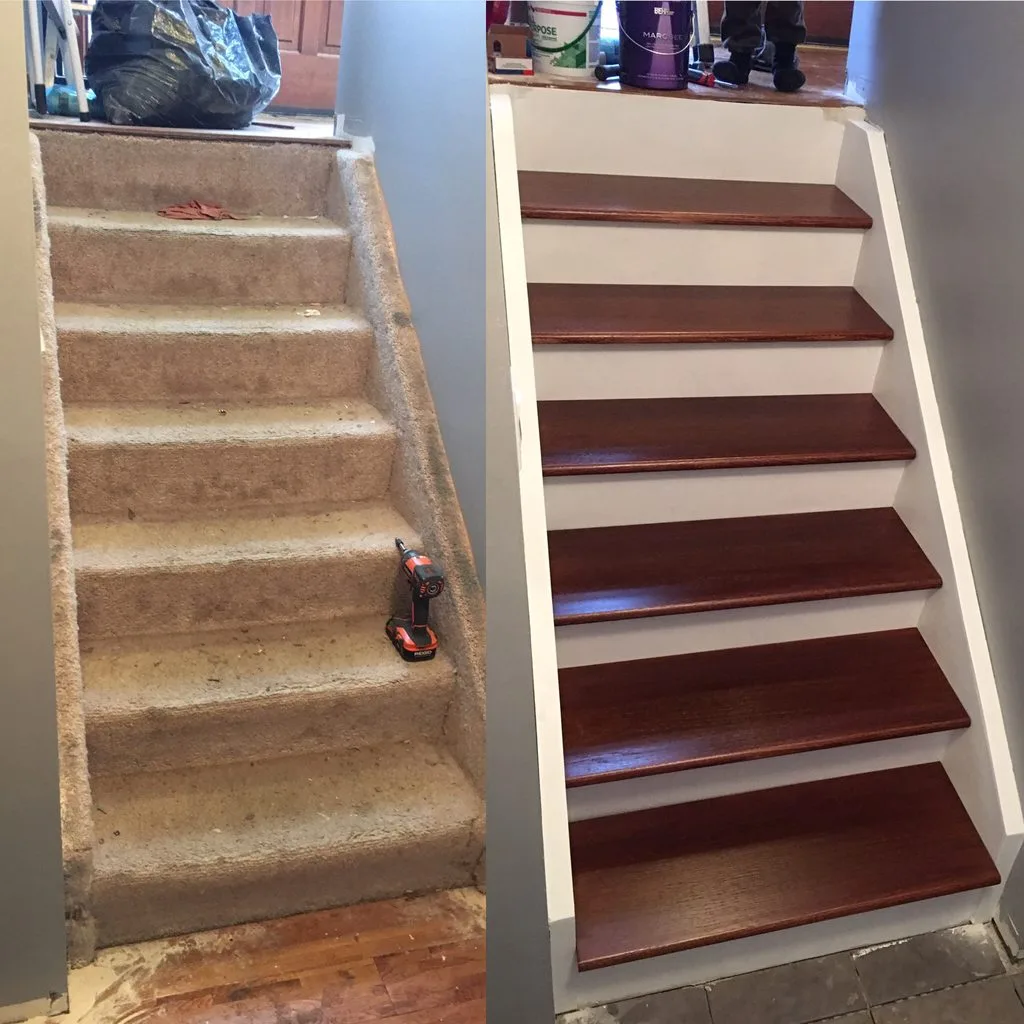
Carpet lifted, wood fittedTreads, risers, nosingsOpen and closed stringers
Carpet to Hardwood Stairs Calgary Conversions
Hardwood stairs cost $80-$150 per step, set by open or closed stringers, winders, spindles and what sits under the carpet. Taking the carpet off a Calgary staircase and finishing it in wood is a joinery job, not a floor-covering job. Every step carries a tread, a riser, a nosing and two visible edges, and each one is measured.
Flight measured step by step
Nosing profile chosen with the floor
Stringer type identified first
Request a Stair Conversion Quote
Send photos looking up and down the flight, the number of steps, whether the sides are open or closed, and the flooring on the landings above and below.
What sits under the carpet is only confirmed once it is lifted. Scope is reviewed if the substrate differs from what the photos suggested.
The three parts of a hardwood stair conversion
Tread
The walking surface, and the part that has to be flat, secure and thick enough to take a nosing. Depth varies across a flight more often than people expect, so treads are cut individually.
Riser
The vertical face. Painted risers with stained treads is the common Calgary choice, and it changes the material order and the finishing sequence.
Nosing
The projecting front edge. Profile, overhang and how it meets the tread govern both the look and the feel underfoot, and it is the detail that separates a fitted stair from a covered one.
Before and after
A carpeted flight converted to hardwood treads
Lifting the carpet shows what each step is made of. From there every tread, riser and nosing is measured and cut for its own step, which is why a converted flight reads as fitted joinery rather than a covering.
What we check before quoting a Calgary stair conversion
Two staircases with the same step count can be very different jobs.
Open or closed stringers
A closed flight has walls on both sides and simple square cuts. An open side needs a returned end on every tread and mitred detail, and it adds real labour per step.
Spindles and newel posts
Balusters that sit into the tread have to be dealt with individually. Whether they are removed and reset or worked around changes the method and the timeline.
Winders and landings
Pie-shaped winder steps and mid-flight landings are cut one at a time. A straight flight of thirteen is quicker than a flight of ten with a turn in it.
What is under the carpet
Some Calgary flights hide solid wood worth keeping, some hide construction-grade stringers never meant to be seen. Both are workable, but they are different scopes.
Riser height consistency
Adding tread thickness changes riser heights, particularly the top and bottom steps where the stair meets the finished floors.
Carpet to hardwood stairs cost in Calgary
Our rates in Canadian dollars. We charge based on your written quote. Stairs are priced per step, counted from the flight, and open sides, winders and spindles set where each step lands in the rate.
Lifting the old carpet
$1 to $3 per sq ft
Our rate for removing existing floor covering. Stairs run slower than open rooms because every staple and tack strip is taken out by hand.
What a carpet to hardwood stair conversion involves
A staircase is not a small floor. It is a set of repeated joinery units, and the quote follows the step count and the complexity of each step, not the square footage.
Open and closed stringers on a hardwood stair
A closed flight, walled on both sides, is the straightforward version. Treads are cut to fit between two walls and the ends are hidden. An open side, where the stair is visible from the room, is a different job. Each tread needs a returned end, mitred so the grain turns the corner cleanly, and that detail repeats on every step. Flights with one open side and one closed side are common in Calgary bungalows and split levels, and they sit between the two in labour.
Hardwood treads, risers and nosings
The tread is the walking surface and has to be flat, solidly fixed and deep enough to carry a nosing. Depths vary along a flight more often than homeowners expect, so treads are measured and cut individually rather than batch-cut.
The riser is the vertical face. Stained treads with painted risers is the usual Calgary choice, and it is a practical one: it costs less than matching wood throughout, and it makes the joint between tread and riser more forgiving.
The nosing is the projecting front edge, and it is the detail that decides whether a stair looks fitted or covered. Profile and overhang get chosen alongside the flooring on the landings, so the top step reads as part of the floor above it rather than an add-on.
Lifting the stair carpet: what is underneath
Nothing about a carpeted stair is confirmed until the carpet is lifted. Homes in the 1960s to 1980s bungalow ring frequently have solid treads underneath that are worth keeping. Newer suburban builds usually have construction-grade treads that were never intended to be seen, which get capped with new material instead.
Staples are the tedious part. A carpeted flight can hold hundreds of them, and every one comes out by hand before anything is fitted. This is also the moment to chase squeaks, since stringers and tread ends are briefly exposed and can be refastened.
Riser height is the technical check. Adding tread thickness raises each step slightly, and the effect concentrates at the top and bottom where the stair meets the finished floors above and below. Those two steps get planned deliberately.
Hardwood stairs through a Calgary winter
Wood on a staircase is subject to the same dry-air behaviour as wood on a floor, and Calgary is a demanding place for it. Heated indoor relative humidity here routinely falls under 30 per cent in winter, below the 30 to 50 per cent range that both Health Canada and the National Wood Flooring Association recommend. Chinooks make the swings sharper by moving outdoor conditions dramatically within hours.
On a stair, that shows up as a hairline opening at the joint between tread and riser through the coldest months, closing again in spring. It is seasonal movement in a natural material, not a fault. Acclimatising the material properly before fitting, and keeping indoor humidity from bottoming out, is what keeps it to a hairline.
The other Calgary factor is grit. Below minus fifteen degrees the City treats roads with pickle, a mix that is mostly fine gravel rather than salt, and it arrives indoors on boots all winter. The top flight from an entry takes the worst of it, which is a reason to think about finish durability and a mat at the door.
Carpet to hardwood stair questions in Calgary
Is there usable wood under my carpeted stairs?
Sometimes. Many Calgary homes from the 1960s to the 1980s have solid treads under the carpet that clean up well. Newer builds more often have construction-grade treads that were always meant to be covered, and those get capped with new material rather than sanded.
Do the risers have to be wood as well?
No. Stained treads with painted risers is a common and durable combination, and it costs less than matching wood throughout. It also hides the joint line between step and riser more forgivingly.
Can the stairs match my existing hardwood floor exactly?
Close, rarely exact. Stair treads are thicker stock than floor boards, they take stain differently, and an existing floor has aged. We aim for a deliberate match at the top and bottom landings rather than an invisible one.
Why do open-sided stairs cost more?
Every tread on an open side needs a returned, mitred end that reads as a finished edge from the room. That is joinery on each step, repeated the length of the flight.
Will the stairs squeak afterwards?
Lifting the carpet is the right time to find and fix squeaks, because the treads and stringers are exposed. We refasten what we can reach, though a squeak coming from framing behind a closed stringer may not be reachable from above.
How long is the flight out of use?
It depends on the finish system and the step count. We set out the working sequence, including which steps are usable at which stage, before the job starts.
Related flooring services
Stair Refinishing in Calgary
Stair refinishing in Calgary: sanding treads in place, masking spindles and handrails, finish cure times and how the household uses the flight meanwhile.
Hardwood flooring installation in Calgary: solid and engineered boards, subfloor levelled and moisture checked for dry chinook winters. Free written quote.
Vinyl plank flooring installed across Calgary: rigid core LVP for basements, kitchens and entries, with the subfloor levelled first. Get a free written quote.
To provide the best experiences, we use technologies like cookies to store and/or access device information. Consenting to these technologies will allow us to process data such as browsing behaviour or unique IDs on this site. Not consenting or withdrawing consent, may adversely affect certain features and functions.
Functional
Always active
The technical storage or access is strictly necessary for the legitimate purpose of enabling the use of a specific service explicitly requested by the subscriber or user, or for the sole purpose of carrying out the transmission of a communication over an electronic communications network.
Preferences
The technical storage or access is necessary for the legitimate purpose of storing preferences that are not requested by the subscriber or user.
Statistics
The technical storage or access that is used exclusively for statistical purposes.The technical storage or access that is used exclusively for anonymous statistical purposes. Without a subpoena, voluntary compliance on the part of your Internet Service Provider, or additional records from a third party, information stored or retrieved for this purpose alone cannot usually be used to identify you.
Marketing
The technical storage or access is required to create user profiles to send advertising, or to track the user on a website or across several websites for similar marketing purposes.