Indus service areaRural area east of CalgarySlab assessed before product
Flooring in Indus, Alberta
On a slab, the concrete decides what is possible above it. Our rates (CAD) are $2-$6 per sq ft for levelling, quoted as its own line, then $6-$12 for vinyl plank or $8-$25 for tile over the prepared slab. We survey the plane, record moisture and look properly at the cracks before anyone starts talking about a product.
Whole slab surveyed, not one room
Cracks assessed for offset, not just width
Levelling priced as its own line
Request an Indus Flooring Quote
Tell us the area, the ceiling height, what is on the floor now, any damp patches or cracks you have noticed, and what the space will be used for.
Slab condition is assessed on site, and product suitability follows the slab rather than the other way round.
What gets recorded on a slab before we quote it
A scope that skips the concrete is a guess wearing a number.
Moisture and evidence of past water
Damp patches, efflorescence and staining, plus whether the product being considered calls for an actual moisture test rather than a visual check.
Flatness across the whole plane
High and low points measured across the full slab instead of room by room, because a slab that has moved does not respect the walls that were built on top of it.
Cracks, width and vertical offset
Crack width matters less than whether the two sides still sit level with each other. A lip means something moved, and it shortens the list of finishes that will work over it.
Penetrations and service access
Floor drains, sump lids, cleanouts and any radon rough-in located first, so nothing that needs reaching later ends up buried under a finished floor.
Finished height
Membrane, panel, underlay and finish thickness added together and checked against ceiling height, door swings and the bottom stair riser before anything is ordered.
Indus project
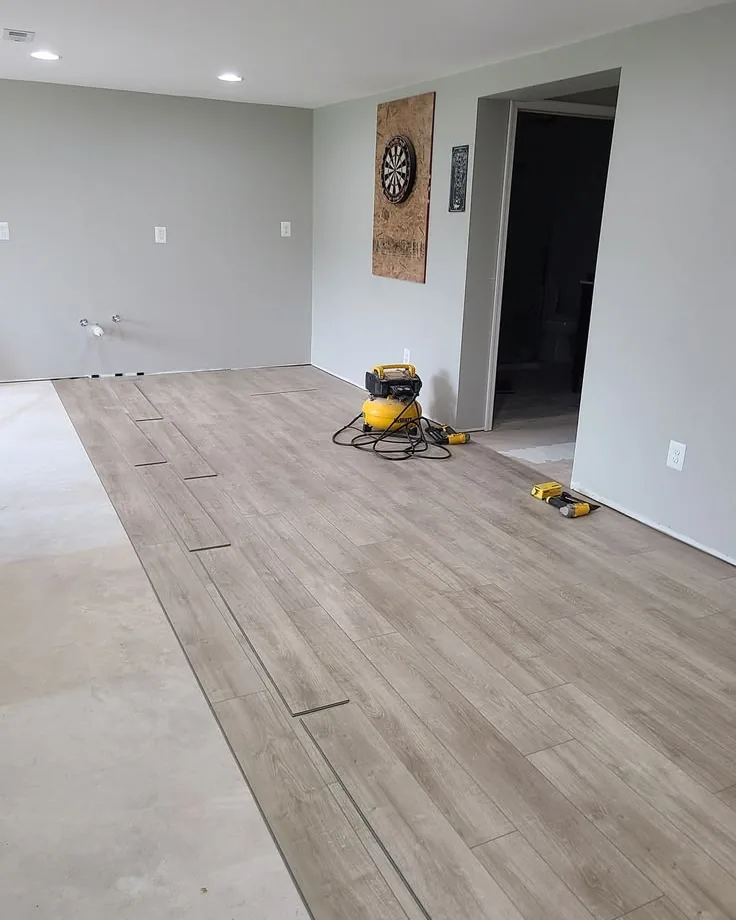
Slab ground and levelled before vinyl plank
On a basement slab out here, the concrete decides what is possible, and a floating vinyl plank shows every hump and dip it sits over.
The slab is surveyed for flatness, moisture is recorded and cracks are looked at properly. High spots are ground down, low spots are filled with levelling compound, and anything that goes through the concrete is done first. The vinyl plank goes down once the surface meets the product’s flatness tolerance.
Pictured: our Indus project – light vinyl plank being laid across a levelled basement slab, with a shop vacuum and tools nearby.
Our rates in Canadian dollars. We charge based on your written quote. Levelling is the line that moves most, because the quantity of compound depends entirely on how far out of flat the slab is.
Most popular
Floor levelling
$2 to $6 per sq ft
Our rate for levelling and self-levelling compound. On a heaved slab this is a real cost line rather than a rounding error, and it is quoted separately for that reason.
Our rate for vinyl and luxury vinyl plank over a prepared slab. Rigid-core products bridge minor surface texture but do not correct a slab that has moved.
Expansive clay reaches the slab before it reaches the footings
Indus sits in open country close to Calgary's eastern edge, and the ground under this whole region is the reason basement floors get their own conversation.
Expansive, shrink-swell clay is widespread across Alberta. It takes on water and swells, dries out and contracts, and it does not do either evenly. What surprises most homeowners is that basement floor slabs move with it far more than footings do, which is why a heaved or cracked slab is a much more ordinary finding than foundation damage.
The practical consequence is that a basement can look entirely normal and still be out of flat by a noticeable amount from one corner to the other. It is also why we survey the whole slab plane rather than the room being finished. A slab does not stop moving at a partition wall that was framed on top of it.
Grinding, filling and the line item people overlook
Once the plane is mapped, the preparation splits into two jobs.
High points get ground back. Low areas get filled with self-levelling compound. Which of the two dominates depends on where the concrete has moved, and a large open area that has lifted in the middle often needs both. The quantity of compound is what makes this a real cost line, not a rounding error, and it is a common reason a floor quote changes after someone has looked at the slab.
Crack assessment runs alongside it but answers a different question. Width is less important than whether the two sides still sit level with each other. A tight, stable crack with no vertical offset is a preparation item and nothing more. A crack with a lip tells you something moved, and it narrows what can sensibly go over it. Rigid plank tolerates a little of this. Tile tolerates almost none.
We quote levelling as its own line for exactly that reason. Folded into a per-square-foot figure it becomes invisible, and invisible costs are the ones that turn into arguments.
Anything that penetrates the concrete happens first
The last part is sequencing, and it costs nothing except a conversation in the right week.
Health Canada's radon action level is 200 Bq/m3. Where a property tests at or above it, mitigation normally means work at the slab: a core for sub-slab depressurization, plus sealing of cracks, the sump lid and other openings. We do not test for radon and we do not install mitigation systems. What we can do is make sure that work, if it is coming, happens before the finished floor rather than after it.
The same logic covers drainage work, plumbing under the slab and any framing that has to be fastened through the concrete. Get everything that penetrates the slab finished, then floor it once. Cutting into a new floor to reach the concrete underneath is entirely avoidable.
Slab and levelling questions on Indus properties
Why is the basement slab cracked when the foundation looks fine?
Because they are not the same thing, and the clay under this region moves them differently. For the new floor, what matters is whether both sides of each crack still sit level, which we check before quoting.
Can vinyl plank go straight onto the slab?
Often yes, provided the slab is clean, sound, dry enough for that product and inside the flatness tolerance written into the manufacturer's instructions. Rigid-core plank bridges small surface texture. It does not correct a slab that has heaved or is still moving, and pretending otherwise just moves the problem to the surface later.
How do I tell whether levelling will be needed before you arrive?
A long straight edge or a level laid across the floor in several directions will show you most of it. Rocking, daylight under the edge or a marble that consistently rolls the same way are all worth mentioning. It will not replace a proper survey, but it tells us what to expect.
Will a new floor do anything about radon?
No. Radon testing and mitigation are separate work carried out by a different trade, not by us. It matters to flooring only for sequencing, because mitigation involves coring the slab and sealing openings, and that should happen before a finished floor goes down.
What if the slab is still moving?
Then we say so, and the list of workable finishes gets shorter rather than longer. A tight, stable crack with both sides level is a preparation item. A crack with a lip is a movement problem, and tile is the least tolerant thing you can put over one.
Flooring services for this area
Floor Leveling in Calgary
Floor leveling in Calgary: flatness tolerance, levelling compound, feathering and heaved basement slabs. Send room details for a floor prep quote.
Basement flooring in Calgary starts at the slab: moisture, flatness, heave, finished height and the bottom stair. Send your basement details for an estimate.
Vinyl plank flooring installed across Calgary: rigid core LVP for basements, kitchens and entries, with the subfloor levelled first. Get a free written quote.
Tile installation in Calgary for floors, bathrooms, entries and heated floors. Substrate, membrane and layout planned before the first tile. Free quote.
To provide the best experiences, we use technologies like cookies to store and/or access device information. Consenting to these technologies will allow us to process data such as browsing behaviour or unique IDs on this site. Not consenting or withdrawing consent, may adversely affect certain features and functions.
Functional
Always active
The technical storage or access is strictly necessary for the legitimate purpose of enabling the use of a specific service explicitly requested by the subscriber or user, or for the sole purpose of carrying out the transmission of a communication over an electronic communications network.
Preferences
The technical storage or access is necessary for the legitimate purpose of storing preferences that are not requested by the subscriber or user.
Statistics
The technical storage or access that is used exclusively for statistical purposes.The technical storage or access that is used exclusively for anonymous statistical purposes. Without a subpoena, voluntary compliance on the part of your Internet Service Provider, or additional records from a third party, information stored or retrieved for this purpose alone cannot usually be used to identify you.
Marketing
The technical storage or access is required to create user profiles to send advertising, or to track the user on a website or across several websites for similar marketing purposes.