Cross-layered coreWear layer checked firstSlab and plywood methods
Engineered Hardwood Calgary Installation
Engineered hardwood installation is $6 to $15 per square foot, with the board, substrate preparation, layout and old floor removal setting the final figure. Engineered hardwood holds its width better than solid boards through a dry Calgary heating season, but only if the wear layer, plank width and substrate method are settled before the product is ordered. About 1,000 sq ft nailed or glued down in cleared rooms takes 3-5 working days.
Wear layer and width reviewed against the room
Glue, float, staple or nail matched to the substrate
Humidity and acclimation planned, not assumed
Request an Engineered Hardwood Quote
Send room dimensions, what is on the floor now, whether the space is on a slab, and any product you have already picked.
Scope depends on measurement, substrate condition and the manufacturer instructions for the board you choose.
Engineered hardwood plank width in a dry Calgary winter
Wide planks are the current look, and they are also where seasonal shrinkage shows first. A gap that would be invisible on a 3 inch board becomes a visible line on a 7 inch board, because the same percentage of movement is spread over more than twice the width. In a Calgary house with no humidification, wide plank engineered hardwood is a look you can still have, but it should be chosen knowingly rather than by accident. Narrower boards, a tighter core construction, or a plan to keep winter humidity up are all legitimate ways to reduce how much the floor tells you about the season.
What an engineered hardwood scope settles before delivery
Engineered boards are a system. The parts below decide whether the finished floor behaves.
Wear layer and construction
The real wood layer over the core sets whether the floor can ever be sanded, and how much abuse the surface tolerates. It is on the product data sheet, not the sample board.
Approved installation method
Glue down, float, staple or nail. The product instructions and the substrate together decide which is permitted, and mixing them up voids the manufacturer guidance.
Substrate condition
Flatness, soundness, cleanliness and moisture. Concrete and plywood are assessed differently and each has its own test before boards are placed.
Humidity and acclimation plan
Storage location, site conditions and how long the material sits before installation, taken from the product sheet rather than a rule of thumb.
Edges and height
Perimeter expansion, doorways, vents, stair nosings, cabinet toe kicks and how the new height meets the floors it touches.
$6-15Our hardwood install rate per sq ft, CAD
3-5 daysTypical install for about 1,000 sq ft, nailed or glued, in cleared rooms
Aspen Woods project
Wide engineered hardwood across a main floor
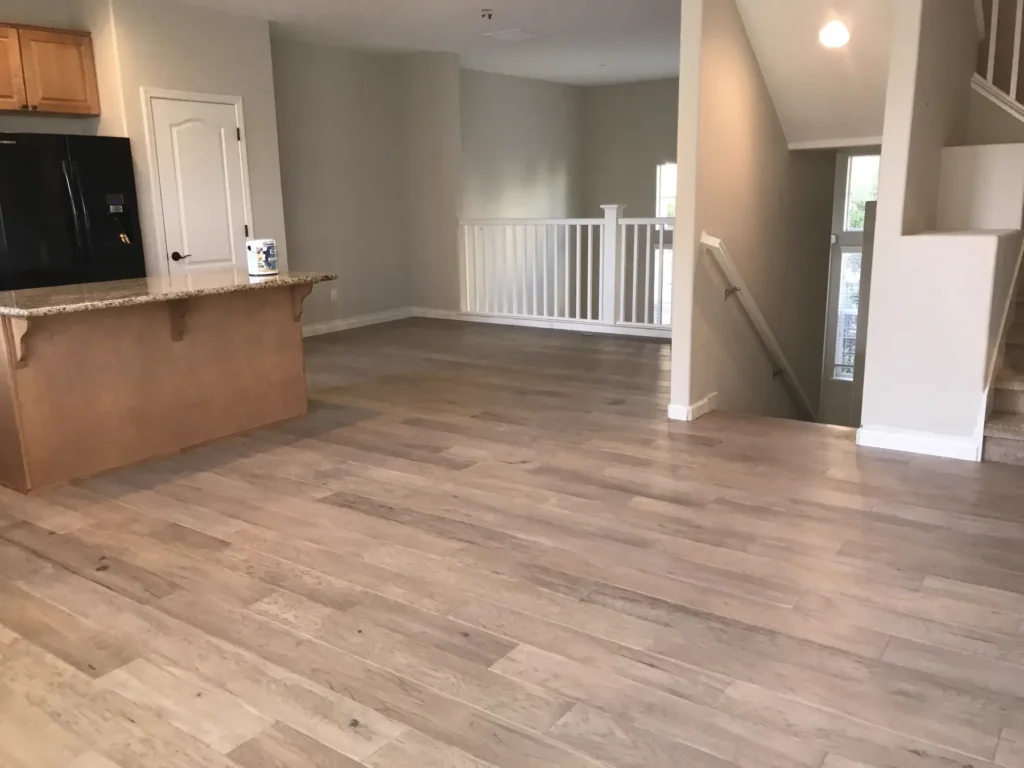
Larger Aspen Woods floor plans tend to connect the entry, main hall, kitchen and living areas, often with a stair rising out of the same space. One wide engineered board carried through all of it gives the cleanest result. The work is in the edges: stair nosings matched to the floor, trim details at each opening, and transitions planned before the first row goes down, with the subfloor checked for flatness to the tolerance a wider board needs.
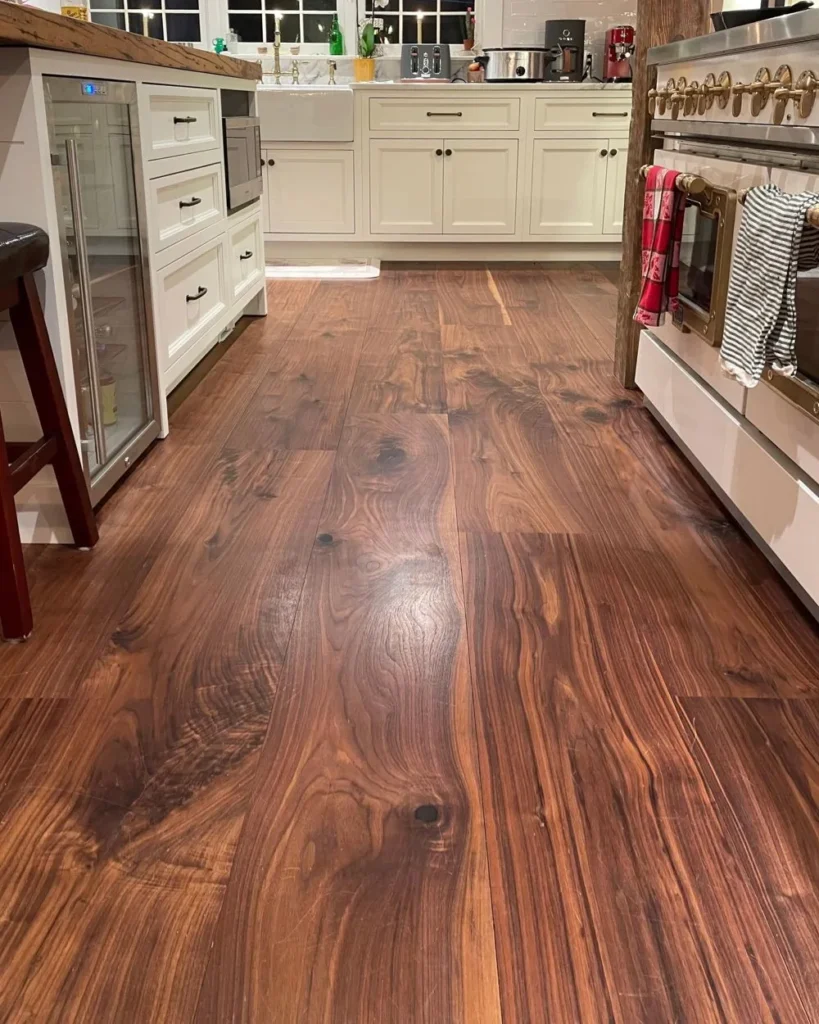
In the photo: wide-plank hardwood carried through the kitchen of an Aspen Woods main floor.
The winter is why engineered hardwood suits this city. This is chinook country. Warm, dry downslope wind can swing the outside temperature more than 20 degrees in a matter of hours, the furnace runs for months, and heated indoor relative humidity routinely sits under 30%. That is below the 30 to 50% range that both Health Canada and the National Wood Flooring Association recommend.
Solid boards answer dry air by shrinking across the grain. Engineered boards are a real wood wear layer over a cross-layered core, so the same moisture swing produces less width change. Less is not none. An engineered floor in a dry Calgary house will still open fine seasonal seams in February and close most of them by June. What the construction buys you is a smaller number, not a floor that ignores the weather.
If the house has no humidification, settle the plank width and the winter humidity plan before the boards are ordered. A whole-home humidifier, or a deliberate plan for the rooms that matter most, changes which plank width is sensible.
Engineered hardwood wear layer thickness and refinishing
The key number on an engineered product sheet is the thickness of the real wood layer over the core. It sets how much surface damage can be sanded out, and whether the floor can be refinished at all or only screened and recoated. Two boards that look identical in a showroom can be years apart in what they will tolerate.
That number also interacts with how the floor gets used. Calgary tracks in a lot of grit over winter, and grit under a chair or a boot is abrasive. A thicker wear layer with a hard factory finish takes that better than a thin one, particularly in an entry, a hallway or a main-floor traffic lane.
Engineered hardwood installation over Calgary slabs and plywood
Substrate comes first, then the permitted method, then the board. Whether the floor is going over plywood on joists, over an existing subfloor, or over a basement slab determines which installation methods the manufacturer permits. Only then does the board selection narrow.
Concrete deserves particular attention here. Expansive clay is widespread under Calgary, and it moves basement floor slabs far more than footings, so heaved and cracked slabs are more common than foundation damage. A slab that is out of flat, or moving, is a subfloor problem before it is a flooring problem. We would rather find it with a straightedge and a moisture test than after the boards are down.
Height is the last item and the one most often forgotten. New board thickness plus any underlayment has to meet stairs, door jambs, vents, cabinet toe kicks and the neighbouring floors. Those details belong in the scope in writing, so the finished floor is not a surprise at the doorway.
Engineered hardwood flooring questions in Calgary
Does engineered hardwood still gap in a Calgary winter?
Yes, less than solid hardwood but not never. Some seasonal movement through the heating season is normal. Narrower planks and a way to add humidity both reduce how visible it is.
Can engineered hardwood be installed on a basement slab?
Some engineered products are approved over concrete and some are not. Before that question can be answered we need the slab checked for flatness, moisture and movement, and we need the product instructions in hand. In a Calgary basement, the slab check is not a formality.
How thick does the wear layer need to be?
It depends on what you want from the floor later. A thin wear layer can usually only be screened and recoated, while a thicker one may allow a full sand at some point. The product data sheet states the thickness, and that number should be part of the decision rather than found out afterwards.
What plank width suits a dry Calgary house?
There is no single answer, but wider boards show seasonal gaps more clearly because the same percentage of shrinkage is spread over a wider board. If the house has no humidifier, we will say so when you are choosing width.
How much does engineered hardwood installation cost?
Our rate for hardwood installation is $6 to $15 per square foot in Canadian dollars. We charge based on your written quote. Product, substrate preparation, layout and removal of the old floor set your final price.
Related flooring services
Hardwood Flooring Installation in Calgary
Hardwood flooring installation in Calgary: solid and engineered boards, subfloor levelled and moisture checked for dry chinook winters. Free written quote.
In Floor Heating and Heated Floor Installation in Calgary
In floor heating in Calgary from the flooring side: electric mat under tile, height build-up, transitions and sensor placement. Send your room details.
Basement flooring in Calgary starts at the slab: moisture, flatness, heave, finished height and the bottom stair. Send your basement details for an estimate.
Get your engineered hardwood substrate reviewed before ordering
Send your room dimensions, the existing floor and the engineered board you are considering, and we will come back with a scope that separates preparation from installation.