Beiseker service areaPrairie community northeast of CalgaryMeasured before ordering
Flooring in Beiseker, Alberta
Most of the avoidable trouble in a flooring job starts at the order. Our installed rates are $3-$8 per sq ft for carpet with underpad and $6-$12 for vinyl plank, plus $1-$3 per sq ft to remove the old floor, with stairs counted step by step. Any figure before the site measure is preliminary, and we charge from the written quote. The wrong quantity, a second dye lot or a missing stair nosing are all decided weeks before anyone picks up a tool.
Measured room by room, including closets
Waste factor stated rather than hidden
Accessories ordered with the field material
Request a Beiseker Flooring Quote
Send a room-by-room list with approximate sizes, what is on the floor in each, and any product you are already considering.
Order quantities follow a site measure. Any figure given before that is a preliminary price, and we charge based on the written quote.
Our Process
From a room list to a material order
1
Measure on site
Every room, doorway, closet and stair measured individually rather than taken from a total house area. Closets, angled walls and stairs are where estimates made from plans go wrong.
2
Set the layout
Decide direction, the starting line and where a run has to break. Layout changes both how the floor looks and how much material the room consumes.
3
State the waste factor
Add a named allowance for cuts, pattern repeat, diagonal layouts and off-cuts, and show what it is. A waste factor folded silently into a total is a figure nobody can check.
4
Order field and accessories together
Field material, underlay, stair nosings, reducers, T-mouldings and trim ordered in one go, so they come from the same production run wherever the manufacturer allows it.
Beiseker project
Stair and floor carpet from one dye lot
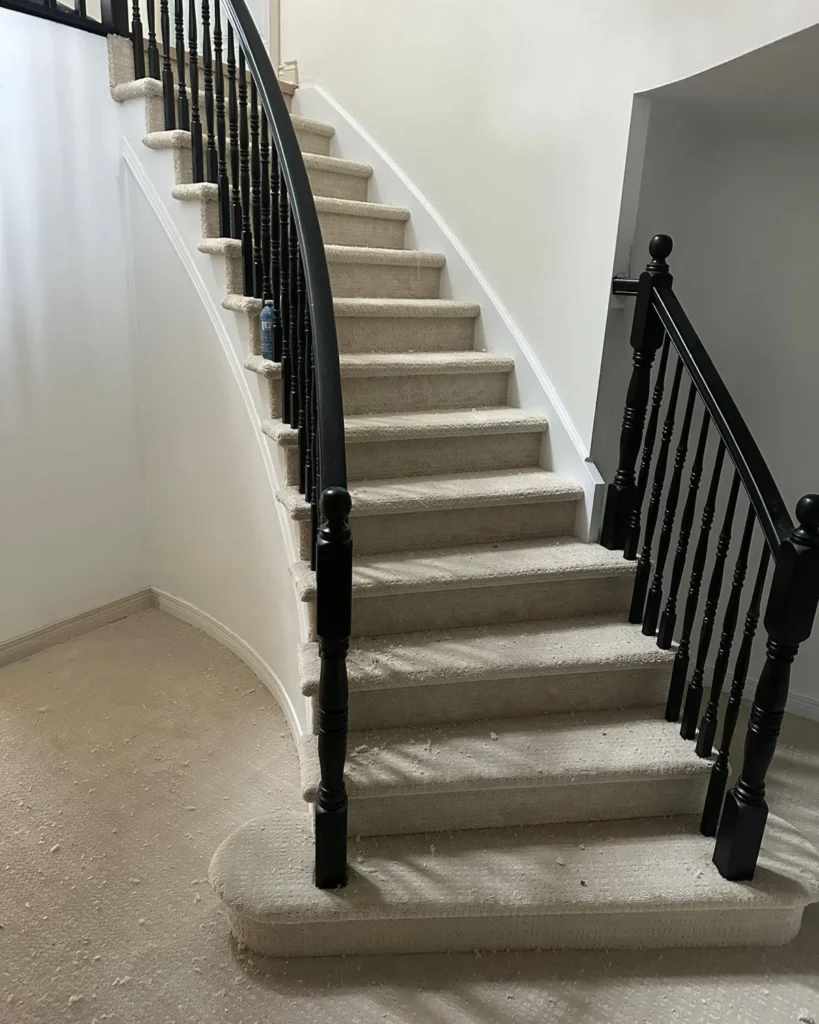
Carpet is where ordering mistakes cost the most. It comes off a roll in fixed widths, so the seam layout is drawn room by room and the stairs are counted step by step, landings and any bullnose included, before the order goes in. Everything on the job is cut from the same dye lot.
On the day, the old carpet, underpad and staples come out, damaged tack strip is replaced, and the new carpet is power stretched in the rooms and wrapped tight over each stair nosing. Keep a labelled offcut from the same lot for any repair later on.
Pictured: our Beiseker project – curved staircase with new beige carpet wrapped over each tread and a black iron railing.
$1-3Our removal and disposal price per sq ft in CAD
$15-60Our carpet price per stair step in CAD
$3-8Our carpet price per sq ft in CAD
$6-12Our vinyl and LVP price per sq ft in CAD
Measure the rooms, not the house
A house area figure is a useful number for almost everything except ordering flooring.
Rooms are what get floored, and rooms are irregular. Closets, alcoves, angled walls, a bay, the space behind a swinging door, the landing at the top of a stair: all of it consumes material, and none of it appears in a single total. Doorways matter too, because a run continuing through an opening behaves differently from two rooms treated separately.
Stairs are the clearest case. A staircase is counted tread by tread rather than converted into an area. A winder or a landing changes that count again. When an estimate is badly wrong, a stair is usually somewhere in the explanation.
So the sequence is a room-by-room list first, then a site measure, then an order. Any price given before we measure is a preliminary figure, and we charge based on the written quote that follows.
Waste factor, dye lots and the piece you will want in three years
Three ordering details cause most of the arguments in this trade, and all three are avoidable.
The waste factor is the allowance for cuts, pattern repeat, layout and off-cuts. It exists on every job. We would rather show it as a line than fold it into a total, because a stated allowance is one you can question and an unstated one is one you cannot.
Dye lots are the second. Carpet, tile and printed vinyl are produced in batches, and batches drift slightly in shade. A patch ordered eighteen months later is unlikely to match the floor it is going into. Ordering the whole job at once, including the allowance, deals with that.
The third is attic stock. A few spare boards or a carpet remnant from the original batch turns a future repair from a visible one into an invisible one. It is worth keeping, and it is worth keeping properly.
Where material waits, and why that matters here
Flooring should acclimate in the space it is going into, at the temperature and humidity that space will normally hold.
That rules out the two places material usually ends up on a rural property: an unheated shop and a garage. Neither is anything like the heated room the floor will live in, and wood that equalises out there arrives at the room already wrong.
Winter delivery adds one more step. Material brought in cold should not be opened and installed the same hour. Give it time in the heated space, and use a meter on both the flooring and the subfloor rather than a number of days from a rule of thumb.
Ordering and measurement questions in Beiseker
Can you quote from a floor plan or a set of drawings?
A plan is a good starting point and it is enough for a preliminary price. It is not enough to order from. Plans miss closets, alcoves, the exact stair count and whatever a previous renovation changed, and the difference between a drawn room and a built one is regularly a box of material.
What is a waste factor and why is it on my quote?
It is the extra material needed for cuts at walls, pattern repeat, diagonal or herringbone layouts, and the off-cuts that cannot be used elsewhere. Every job has one. The only real question is whether it is stated openly or quietly rolled into the total, and we state it.
What is a dye lot and does it matter?
It is the batch a run of material was produced in. Carpet, tile and printed vinyl can all shift slightly in shade between batches, enough to notice under a window or across a doorway. Ordering the whole job at once, with the waste allowance included, avoids finding out later.
Should I keep the leftover material?
Yes, if there is somewhere sensible to put it. A few boards or a spare carpet remnant from the original batch is the difference between an invisible repair and a visible one years later. Store it flat, indoors, in heated space, not stood on end in an unheated shop.
Do accessories really have to be ordered at the same time?
They do, more often than people expect. Stair nosings, reducers, vents and matching trim can run on different lead times from the field material, and a floor that is finished except for the stair nose is not a finished floor. Where an exact accessory is unavailable, that gets decided before installation sets the height and the edge.
Flooring services for this area
Carpet to Hardwood Stairs in Calgary
Converting carpet stairs to hardwood in Calgary: treads, risers, nosings, open and closed stringers. Send photos of the flight for a scoped estimate.
Vinyl plank flooring installed across Calgary: rigid core LVP for basements, kitchens and entries, with the subfloor levelled first. Get a free written quote.
Hardwood flooring installation in Calgary: solid and engineered boards, subfloor levelled and moisture checked for dry chinook winters. Free written quote.
To provide the best experiences, we use technologies like cookies to store and/or access device information. Consenting to these technologies will allow us to process data such as browsing behaviour or unique IDs on this site. Not consenting or withdrawing consent, may adversely affect certain features and functions.
Functional
Always active
The technical storage or access is strictly necessary for the legitimate purpose of enabling the use of a specific service explicitly requested by the subscriber or user, or for the sole purpose of carrying out the transmission of a communication over an electronic communications network.
Preferences
The technical storage or access is necessary for the legitimate purpose of storing preferences that are not requested by the subscriber or user.
Statistics
The technical storage or access that is used exclusively for statistical purposes.The technical storage or access that is used exclusively for anonymous statistical purposes. Without a subpoena, voluntary compliance on the part of your Internet Service Provider, or additional records from a third party, information stored or retrieved for this purpose alone cannot usually be used to identify you.
Marketing
The technical storage or access is required to create user profiles to send advertising, or to track the user on a website or across several websites for similar marketing purposes.