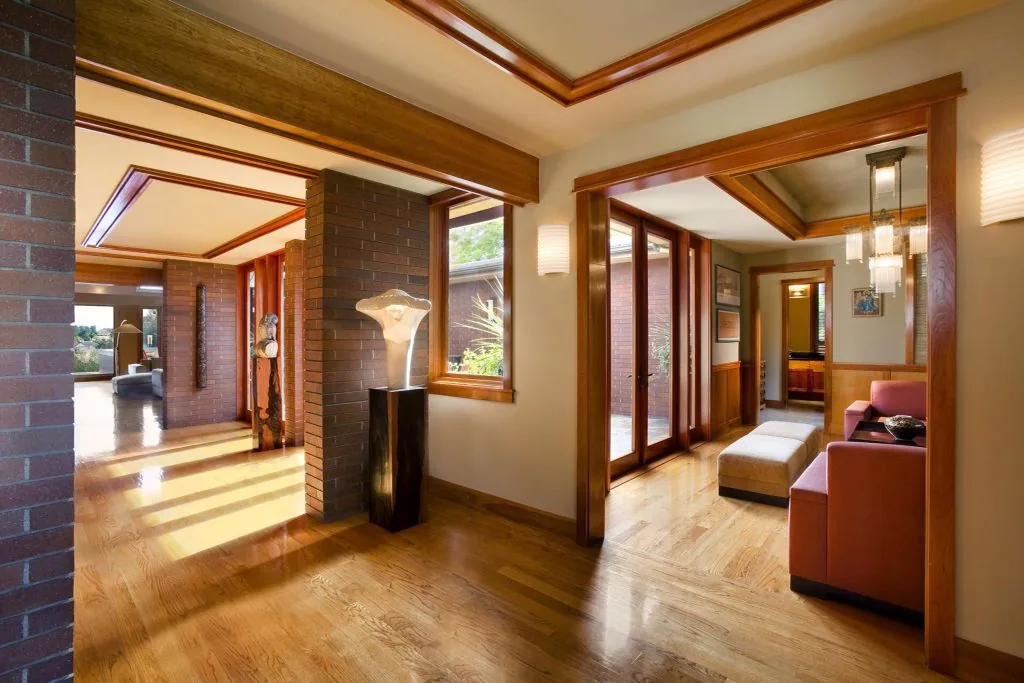
Carstairs service areaPrairie town north of CalgaryInstallation and repair
Flooring in Carstairs, Alberta
Wood floors in this part of Alberta spend the winter in air that is drier than the flooring industry recommends. Species, board width and acclimation get decided around that, before anything is ordered.
Acclimation planned before delivery
Plank width matched to the room
Seasonal movement explained up front
Request a Carstairs Flooring Quote
Tell us the rooms and their approximate sizes, what is on the floor now, and whether the house has a humidifier on the furnace.
Measurements and a look at the existing floor are needed before any figure becomes a quote.
What we record before ordering wood for a Carstairs house
Most of what decides how a wood floor behaves is settled before the material arrives.
Heating season humidity
Whether the house has a humidifier on the furnace, how it is set, and what the indoor reading actually is in January rather than in July.
Moisture content, measured
The moisture content of the subfloor and of the boards, taken with a meter rather than assumed, so the two sit close together before anything is fastened down.
Where the material acclimates
Flooring should sit in the room it is going into, at the temperature and humidity that room will normally hold. A cold garage or an unheated shop gives a reading that means nothing.
Board width and construction
Wide solid boards show seasonal movement most clearly. Narrower widths and engineered construction move less. This is a selection decision rather than something corrected on site.
Heat sources and fixed obstacles
Floor registers, hearths, exterior doors and south-facing glass create local conditions on a floor that differ from the middle of the room.
The dry season problem
Indoor air here spends the winter below the band wood likes
Southern Alberta sits in the chinook belt, and heated indoor air through the winter routinely falls well under 30 per cent relative humidity. That is below Health Canada’s winter guidance of roughly 30 to 35 per cent, and well below the 35 to 55 per cent band the National Wood Flooring Association associates with dimensional stability in wood. Boards give up moisture, shrink across their width and open small gaps at the joints. In most houses those gaps close again over the summer. The floor is not failing, it is doing what wood does in dry air.
Flooring Experts Calgary provides flooring installation and repair to homeowners and businesses across Carstairs, Alberta.
Why a floor gaps in February and closes again in July
Carstairs sits on the prairie north of Calgary, in the part of the province where a chinook can move the temperature more than twenty degrees in a matter of hours and the furnace runs hard the rest of the time. The result indoors is air that is genuinely dry. Through the heating season, relative humidity in a heated house here routinely falls well under 30 per cent, below Health Canada's winter guidance of roughly 30 to 35 per cent and a long way below the 35 to 55 per cent band the National Wood Flooring Association ties to dimensional stability in wood.
Wood responds by giving up moisture and shrinking across the width of each board. Joints open slightly. On a wide plank the same percentage of shrinkage shows up as a wider gap, which is why the widest floors always look worst in midwinter. Most of it reverses. By July the boards have taken moisture back on and the gaps have closed to something you stop noticing.
We say this at the quoting stage rather than afterwards, because a homeowner who has not been told will reasonably assume the installation failed.
Deciding width and construction before the order goes in
Almost everything that determines how a wood floor behaves in this climate is settled at selection, not on site.
Board width is the single biggest factor. Narrow boards move the same amount proportionally and far less visibly. Engineered construction, where a wear layer sits over a cross-laminated core, moves less across its width than solid wood of the same size, and that is what makes a wide plank workable in a dry house.
Species and finish matter as well, though less than most people expect. So does what the house does about humidity. A furnace humidifier that is genuinely set and maintained through the heating season keeps the boards closer to the range the manufacturer wrote its instructions around. It does not remove seasonal movement, and no floor should be sold on the promise that it will.
What acclimation is for, and what it is not
Leaving boxes in a room for a fixed number of days is not acclimation. The point is to bring the flooring and the subfloor to a similar moisture content, in the conditions that room will actually hold once people are living in it.
That means the heat on, the house at ordinary humidity, and a meter used on both the material and the subfloor. It also means the flooring is not waiting in an unheated shop or a garage in the meantime, because the moisture content it reaches out there has nothing to do with the room it is going into.
Where a house is new, or has just been through drywall and paint, the building itself is still giving off moisture and the schedule has to account for that too. It is a short conversation at the start of a job and it prevents the long one later.
Wood movement questions we get in Carstairs
My hardwood gapped over the winter. Is the installation at fault?
Usually not. Seasonal gapping across the width of the boards is what dry heating-season air does to wood, and in most houses the gaps narrow again by mid-summer. What is worth looking at is whether the gaps are even across the floor, whether any board has cupped or crowned, and how indoor humidity is being managed.
Will a furnace humidifier stop the gaps?
It helps, because the problem is the air rather than the floor. Holding indoor humidity closer to the range in the manufacturer's instructions through the heating season reduces how far the boards shrink. It rarely removes seasonal movement completely, and the humidifier has to be set and maintained, not simply present.
Should I choose narrow boards instead of wide ones?
Width is the biggest lever you have. A wide plank and a narrow plank shrink by the same percentage, but on a wider board that percentage becomes a gap you can see from standing height. If you want a wide look in a dry house, engineered construction over a cross-laminated core is the usual answer.
How long does the material need to sit before installation?
Long enough for the boards and the subfloor to reach a similar moisture content in the conditions the room will normally hold. The number of days comes from the manufacturer's instructions and from what the meter says, not from a rule of thumb.
What planning range should I use for a wood floor?
For early budgeting we use the site-wide CAD planning range of $6 to $15 per square foot for hardwood installation and $3 to $7 per square foot for refinishing an existing floor. Both are planning ranges for a budget conversation, not quotes.
Send the Carstairs room list and the winter humidity story
What is on the floor now, how the house is heated and which rooms are involved tell us more than square footage alone.
To provide the best experiences, we use technologies like cookies to store and/or access device information. Consenting to these technologies will allow us to process data such as browsing behaviour or unique IDs on this site. Not consenting or withdrawing consent, may adversely affect certain features and functions.
Functional
Always active
The technical storage or access is strictly necessary for the legitimate purpose of enabling the use of a specific service explicitly requested by the subscriber or user, or for the sole purpose of carrying out the transmission of a communication over an electronic communications network.
Preferences
The technical storage or access is necessary for the legitimate purpose of storing preferences that are not requested by the subscriber or user.
Statistics
The technical storage or access that is used exclusively for statistical purposes.The technical storage or access that is used exclusively for anonymous statistical purposes. Without a subpoena, voluntary compliance on the part of your Internet Service Provider, or additional records from a third party, information stored or retrieved for this purpose alone cannot usually be used to identify you.
Marketing
The technical storage or access is required to create user profiles to send advertising, or to track the user on a website or across several websites for similar marketing purposes.