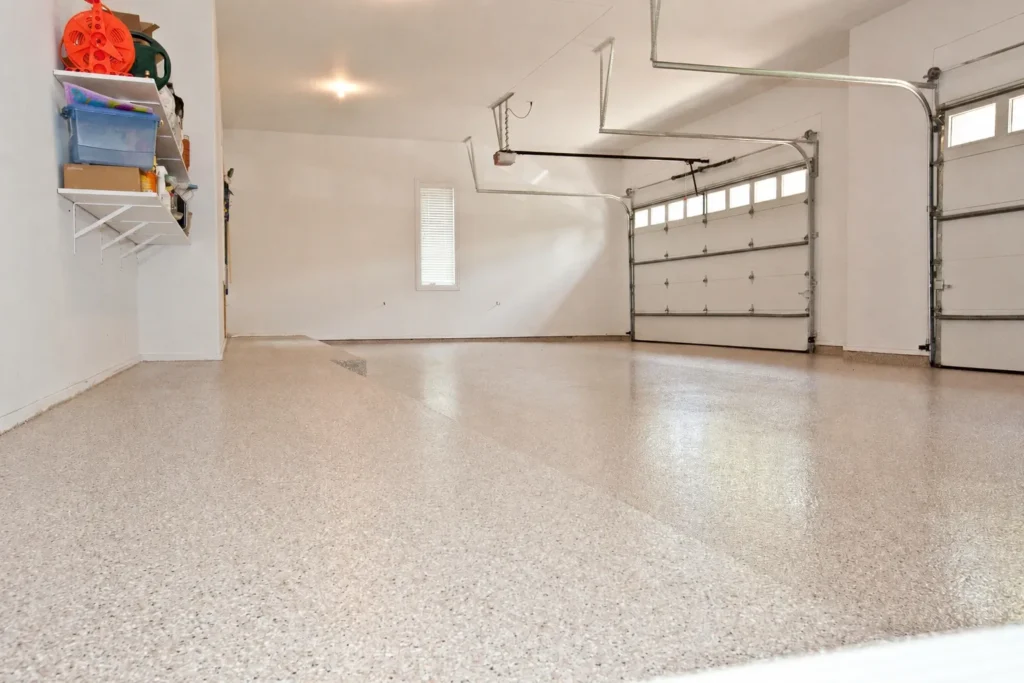
Garage floor coatingsConcrete ground before coatingFree written estimate
Epoxy Flooring and Garage Floor Coating in Calgary
A complete epoxy system is $5 to $12 per square foot installed, with failed-coating removal at $1 to $3 and levelling at $2 to $6 per square foot where needed. We coat Calgary garage, basement and shop floors with epoxy systems over mechanically ground concrete, with cracks repaired and a topcoat chosen for hot tires, road grit and salt. The condition of the slab moves the final number more than the finish does.
Diamond grinding, not acid etching
Crack and joint repair priced up front
Flake, solid colour or metallic finishes
Request an Epoxy Flooring Quote
Share the slab area, current coating, cracks, room use and desired finish.
A coating cannot correct active movement or unsuitable moisture conditions without an appropriate plan.
Garage floor coating
What a Calgary garage floor coating has to survive
The City spreads pickle, a mix of 3% salt and 97% fine gravel, when road surfaces drop below -15°C, and it rides into the garage on tires all winter with the meltwater. Add hot tires lifting at the tire paths and you have the test every garage coating faces. That is why we grind the concrete to open it up, repair cracks before coating, and finish with a topcoat built for abrasion and salt.
What an epoxy garage floor proposal should identify
The coating name is not enough to define the installed system.
Concrete condition
Review age if known, current coating, contamination, repairs, cracks, joints and surface hardness.
Moisture approach
State how moisture risk is evaluated and which limits apply to the proposed materials.
Mechanical preparation
Define grinding or other approved profiling, edge work, cleaning and dust control.
Coating build
List primer, base or build coats, flakes or pigments, topcoat and slip-resistance choices.
Cure and access
Provide product-specific timing for foot traffic, storage, vehicles, cleaning and full service.
Our Process
How an epoxy garage floor is applied to Calgary concrete
1
Inspect the concrete
Review coating history, damage, joints, contamination and moisture, and run an adhesion test on any existing coating before deciding whether it comes off.
2
Choose the system
An epoxy base coat for bond and build, a polyaspartic topcoat for hot tires, grit and sunlight, and a flake broadcast with anti-slip additive for grip when wet.
3
Profile and repair
Diamond grind the slab rather than acid etch it, grind off any peeling coating, then fill static cracks and grind them flush. Cracks that are still moving are pointed out before the quote.
4
Apply and cure
Apply primer, base coat, flake or colour and topcoat in sequence. Vehicles go back on only when the topcoat data sheet allows at the slab temperature, so a winter garage stays heated through the cure.
Epoxy garage floor variables that drive performance
Surface profile
The concrete must provide the clean, sound texture required for the selected coating to bond.
Moisture conditions
A dry-looking surface does not replace the evaluation required by the system specification.
Topcoat and texture
Wear, chemicals, sunlight exposure, cleaning and slip resistance influence the final layer.
Epoxy garage floor cost in Calgary
Our rates in Canadian dollars. The condition of the slab moves the final number more than the finish does.
Most popular
Epoxy coating system
$5-$12 per sq ft
Ground concrete, primer, pigmented base coat, flake or colour, and a clear protective topcoat.
Every epoxy and coating system goes over concrete that has been mechanically ground, with cracks repaired and the slab checked for moisture, because the bond to the concrete decides how long the coating lasts.
Garage Floor Coating in Calgary
A Calgary garage floor coating has to handle hot tires, meltwater and road grit all winter. The City spreads pickle, a mix of 3% salt and 97% fine gravel, when road surfaces drop below -15°C, and it rides into the garage on tires and boots. Peeling at the tire paths is a bond failure, which is why preparation matters more than the product name.
A complete garage floor coating is built in layers: a primer that soaks into the ground concrete, a pigmented epoxy base coat, a decorative flake broadcast, and a clear topcoat chosen for abrasion and UV resistance.
Concrete Preparation: Grinding, Cracks and Moisture
We diamond-grind the concrete to open the surface and remove laitance, sealers and old coatings; acid etching does not produce the same profile and leaves residue. Cracks and spalls are filled with a repair material compatible with the coating, and joints are treated so they can still move. Slabs get a moisture check, and failed coatings are removed by grinding before anything new goes down. See concrete grinding.
Flake, Solid Colour and Metallic Finishes
Choose a full flake finish for garages: it hides dust and tire marks, adds texture for grip and disguises small slab imperfections. Choose solid colour for shops and workspaces where cleaning comes first, and metallic epoxy for basements and showrooms where the look leads. An anti-slip additive goes into the topcoat in any area that gets wet.
Epoxy Garage Floor Cost in Calgary
A complete epoxy or resin coating system, installed, costs $5 to $12 per square foot in Canadian dollars. Removing a failed existing coating adds $1 to $3 per square foot, and slab levelling $2 to $6 where needed. We charge based on your written quote. The condition of the slab moves the final number more than the finish does. Our epoxy garage floor cost guide breaks the price down by garage size and finish, and the flooring cost page covers other floors.
Return to Service
Foot traffic, stored items and vehicles return at three different times, taken from the data sheets for the exact products and the temperature during cure. Cold slabs slow curing, so winter garage work in Calgary needs the space heated during application and cure. The vehicle date is always the last of the three.
Epoxy flooring and garage floor coating questions in Calgary
What is the difference between epoxy flooring and a garage floor coating?
A garage floor coating is the application; epoxy is the material in most of them. A typical garage system uses an epoxy base coat with a polyaspartic or polyurethane topcoat for abrasion and UV resistance.
Epoxy or polyaspartic for a Calgary garage?
Use both: an epoxy base coat bonds to the ground concrete and builds thickness, and a polyaspartic topcoat cures faster and resists yellowing from sunlight. The topcoat takes the hot tires and winter grit.
Can you coat over an old garage floor coating?
Only after an adhesion test. A coating that is peeling, chalky or lifting at the tire paths is ground off first, and removal costs $1 to $3 per square foot.
Do you grind or acid etch the concrete?
We grind. Diamond grinding opens the concrete surface evenly and removes sealers and weak surface layers; acid etching does not give a consistent profile and leaves residue behind.
Can epoxy go over a cracked garage slab?
Yes once the cracks are repaired. Static cracks are filled and ground flush. Cracks that are still moving can reappear through any rigid coating, so we tell you which cracks those are before quoting.
When can I park on a new epoxy garage floor?
When the topcoat data sheet allows vehicle traffic at the cure temperature, which is always later than foot traffic. Cold slabs cure slowly, so in winter the garage needs heating through application and cure.
Is an epoxy floor slippery when wet?
A smooth gloss coating is slippery when wet. A flake broadcast and an anti-slip additive in the topcoat give it grip, and we add both in garages and entries.
What does an epoxy garage floor cost in Calgary?
A complete epoxy coating system, installed, costs $5 to $12 per square foot in Canadian dollars, and removing a failed coating costs $1 to $3 per square foot.
Related flooring services
Concrete Grinding in Calgary
Concrete grinding in Calgary: profiling and prep grinding before a coating or covering, high spots, dust control. Send slab details for a quote.
Warehouse floor coating in Calgary covering slab profiling, joint and crack treatment, forklift traffic, line marking, cure times and return to service.
To provide the best experiences, we use technologies like cookies to store and/or access device information. Consenting to these technologies will allow us to process data such as browsing behaviour or unique IDs on this site. Not consenting or withdrawing consent, may adversely affect certain features and functions.
Functional
Always active
The technical storage or access is strictly necessary for the legitimate purpose of enabling the use of a specific service explicitly requested by the subscriber or user, or for the sole purpose of carrying out the transmission of a communication over an electronic communications network.
Preferences
The technical storage or access is necessary for the legitimate purpose of storing preferences that are not requested by the subscriber or user.
Statistics
The technical storage or access that is used exclusively for statistical purposes.The technical storage or access that is used exclusively for anonymous statistical purposes. Without a subpoena, voluntary compliance on the part of your Internet Service Provider, or additional records from a third party, information stored or retrieved for this purpose alone cannot usually be used to identify you.
Marketing
The technical storage or access is required to create user profiles to send advertising, or to track the user on a website or across several websites for similar marketing purposes.