Ceramic and porcelain tileLarge-format and heated floorsFree written estimate
Tile Installation in Calgary for Floors, Bathrooms and Entries
We install ceramic and porcelain tile on Calgary floors, bathrooms and entries, with the substrate stiffened, flattened and membraned before the first tile is set. Installed tile costs $8-$25 per sq ft, set by the tile, the pattern and the substrate and membrane work, and tile takes longer than a plank floor because setting and grout cure between stages.
Uncoupling and waterproofing membranes
Large-format tile set flat and flush
Layout planned around doors, tubs and drains
Request a Tile Installation Quote
Share room dimensions, tile specification, current surface and the type of area.
Tile, substrate, waterproofing and setting-material requirements must be confirmed together.
Substrate first
Why tile cracks over a Calgary basement slab
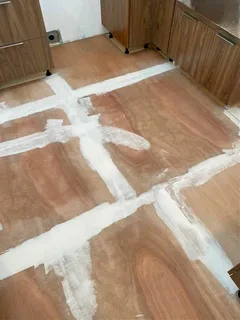
A crack that runs in a straight line through several tiles is the slab moving, not a bad tile. We check every slab for cracks, height changes and moisture, treat stable cracks with an uncoupling membrane, and level out-of-flat floors before tiling.
Tile installation from selection to finished joints
1
Check the slab or subfloor
Look for cracks, height changes and moisture. A crack that is still moving gets repaired first; a stable hairline crack gets an uncoupling membrane.
2
Plan the layout
Dry-plan lines, pattern, focal points, cuts, transitions and edge profiles.
3
Level and set
Bring the floor within the tile's flatness tolerance, then set the tile, with fuller mortar coverage and a clip system on large-format tile so edges sit flush.
4
Grout and detail
Finish joints, changes of plane, exposed edges and return-to-use guidance.
Tile installation decisions visible in the finished room
Balanced cuts
Starting lines and focal points should avoid awkward slivers and keep the pattern deliberate.
Wet-area assembly
Water management relies on the specified membrane, penetrations, transitions and sealant details below the finish.
Edges and changes
Profiles, thresholds, movement joints and changes of plane need materials chosen for their specific role.
Tile installation cost in Calgary
Our rates in Canadian dollars. We charge based on your written quote. The tile, the pattern and the substrate work set your price.
Most popular
Tile installation
$8-$25 per sq ft
Ceramic, porcelain or large-format tile set over the right membrane, grouted and sealed, with edge profiles.
We stiffen and flatten the substrate, add an uncoupling or waterproofing membrane where the room needs one, and plan the layout around doors, tubs, drains and cabinets before the first tile is set.
A tile floor is an assembly: structure, substrate, membrane, mortar, tile and grout. When a tile cracks, the cause sits below the tile, so the assembly is where the work and the quote start.
The Substrate Under the Tile
Tile needs a stiff, flat base. Over a wood subfloor we check deflection and add underlayment where the floor has too much bounce; over concrete we check for cracks, height changes and moisture.
Calgary basement slabs need extra care. Expansive clay moves floor slabs far more than footings, so cracked and heaved basement slabs are common here. We treat stable cracks with an uncoupling membrane rather than tiling straight over them, and correct out-of-flat slabs with floor levelling first.
Tile for Calgary Entries and Mudrooms
Use porcelain at entries and mudrooms. It is dense, absorbs very little water and stands up to the grit that comes indoors all winter: the City's pickle mix is 3% salt and 97% fine gravel, spread when road surfaces drop below -15°C. A matte or textured porcelain stays safer underfoot when snow melts off boots.
Large-Format Tile and Layout
Large-format tile needs a flatter substrate and fuller mortar coverage than small tile, and it shows any height difference between edges. We level the floor to the tile's flatness requirement, back-butter large tiles and use a levelling clip system to keep edges flush.
The layout is set before setting starts. Centre lines get tested against walls, doorways, tubs and vanities so the edge cuts stay balanced and no sliver pieces land at the door.
Heated Floors and Bathroom Tile
Tile pairs well with in-floor heating, and a Calgary winter makes a warm bathroom or basement floor worth planning in. We coordinate the heating mat, sensor and membrane with the tile layout; see heated floor installation and bathroom tile. For cracked or loose tiles in an existing floor, see tile repair.
What Your Tile Installation Quote Includes
Removal of the existing floor or tile
Substrate repairs, underlayment and levelling
Uncoupling or waterproofing membrane where the room needs it
Setting materials, tile installation, grout and sealer
Edge profiles, transitions and movement joints
We charge $8 to $25 per square foot in Canadian dollars for tile installation. Your price within that rate depends on the tile, pattern and substrate work. See the flooring cost page.
Tile installation questions in Calgary
Do you install large-format tile?
Yes. Large-format porcelain needs a flatter substrate and fuller mortar coverage than small tile, so we level the floor first and use a clip system to keep edges flush. Flatness work is priced as its own line.
Does grout make a tile floor waterproof?
No. Grout and tile are the finish. In showers, bathrooms and laundry rooms the waterproofing is a membrane under the tile, and that is what keeps water out of the subfloor.
Can you tile over a cracked concrete slab?
Yes, once the crack is assessed. A stable hairline crack gets an uncoupling membrane over it; a crack that is still moving or has a height change gets repaired first.
Can you install in-floor heating under tile?
Yes. We install electric heating mats under tile and coordinate the sensor, membrane and layout, with the electrical connection made by a licensed electrician.
Ceramic or porcelain for an entry?
Porcelain. It is denser and absorbs less water than ceramic, so it handles meltwater and the fine gravel Calgary tracks indoors all winter. Choose a matte or textured surface for grip.
Do you tile bathrooms and showers?
Yes, floors and showers, with the waterproofing membrane installed under the tile and sloped to the drain.
Can you replace a few cracked tiles instead of the whole floor?
Yes, when matching tile exists and the cause of the cracking has stopped. Our tile repair service covers single tiles, hollow tiles and regrouting.
What does tile installation cost in Calgary?
Installed tile costs $8 to $25 per square foot in Canadian dollars. Your price within that rate depends on the tile, the pattern and the substrate work. Removal adds $1 to $3 per square foot and levelling $2 to $6 where needed.
Related flooring services
Bathroom Tile Installation in Calgary
Bathroom tile installation in Calgary: waterproofing membranes, slope to drain, and small versus large format choices. Send bathroom details for an estimate.
Tile repair in Calgary: cracked and hollow tiles replaced, grout raked out and renewed, and the cause under the tile found first. Send photos for a quote.
In Floor Heating and Heated Floor Installation in Calgary
In floor heating in Calgary from the flooring side: electric mat under tile, height build-up, transitions and sensor placement. Send your room details.
To provide the best experiences, we use technologies like cookies to store and/or access device information. Consenting to these technologies will allow us to process data such as browsing behaviour or unique IDs on this site. Not consenting or withdrawing consent, may adversely affect certain features and functions.
Functional
Always active
The technical storage or access is strictly necessary for the legitimate purpose of enabling the use of a specific service explicitly requested by the subscriber or user, or for the sole purpose of carrying out the transmission of a communication over an electronic communications network.
Preferences
The technical storage or access is necessary for the legitimate purpose of storing preferences that are not requested by the subscriber or user.
Statistics
The technical storage or access that is used exclusively for statistical purposes.The technical storage or access that is used exclusively for anonymous statistical purposes. Without a subpoena, voluntary compliance on the part of your Internet Service Provider, or additional records from a third party, information stored or retrieved for this purpose alone cannot usually be used to identify you.
Marketing
The technical storage or access is required to create user profiles to send advertising, or to track the user on a website or across several websites for similar marketing purposes.