Crossfield service areaOlder homes in the town coreRemoval and levelling
Flooring in Crossfield, Alberta
In an older Crossfield home the interesting part of the job is under the floor you can see. Our rates (CAD) are $1-$3 per sq ft to remove the old covering and $2-$6 per sq ft for levelling, each as its own line, then $6-$12 for vinyl plank, $3-$8 for carpet or $6-$15 for hardwood. Subfloor repair is confirmed once the old floor is up. Layered coverings, plank subfloors and an out-of-flat base decide the scope long before the new material does.
Layers identified before quoting
Levelling costed as its own line
Clear limits on what we will not touch
Request a Crossfield Flooring Quote
Tell us the rooms, rough dimensions, the age of the home and what you know about previous floors that were left in place.
Preparation cannot be fully priced until the old covering is up. Removal, levelling and new floor stay as separate lines for that reason.
Our Process
Working out what is under a Crossfield floor
1
Look at an edge
A vent opening, a threshold or a cut at the closet often shows the whole layer history without lifting anything.
2
Count the layers
Each accumulated covering adds height, disposal volume and removal labour, and each one hides how flat the base really is.
3
Check the base for flat
Plank subfloors and old slabs are measured across the room rather than eyeballed, because modern floating products carry flatness tolerances in their instructions.
4
Price preparation separately
Removal, disposal, subfloor work and levelling stay as their own lines so a surprise underneath does not disappear into the material price.
Crossfield project
Subfloor repair before the new floor
In an older Crossfield house the scope is set by what comes up. Old coverings are removed down to the subfloor, and plank subfloors are checked for loose boards, squeaks and dips before anyone talks about the new material.
Loose boards are refastened, damaged sections are replaced, and the surface is brought within the flatness the new product calls for, often with a plywood overlay on a plank subfloor. The new flooring waits in the room while that work is done.
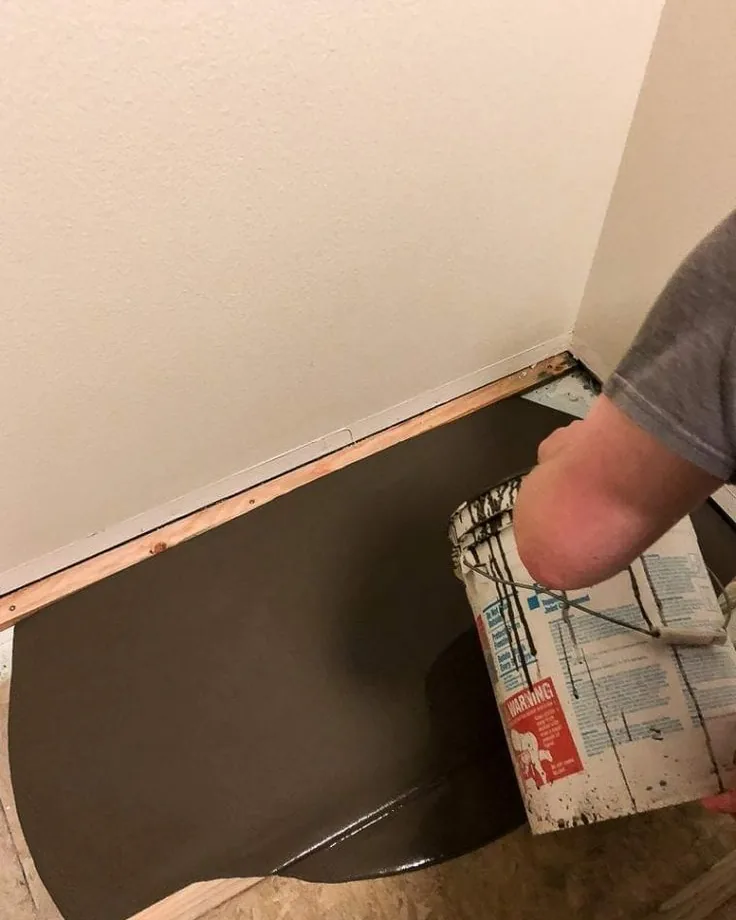
Pictured: our Crossfield project – installer pouring from a bucket onto the prepared subfloor along a wall before the new floor goes down.
None of this is unusual and none of it is a disaster. It is simply what gets missed when a floor is priced by area alone.
Plank subfloors
Boards laid over joists rather than sheet goods, often with gaps between them. Modern click and floating products generally need an overlay panel or a levelling pass to sit on that.
Layers left in place
Covering laid over covering over decades. Each one raises the finished height, and the stack shows up at thresholds, doors and the top and bottom of a stair flight.
An out-of-flat base
Settlement, old repairs and worn traffic lanes leave a floor that is nowhere near the flatness tolerance a modern product specifies in its instructions.
Old adhesives
Cutback and other historic adhesives can be difficult to remove and can interfere with a new bond. What they are decides whether they come off or get covered.
Vinyl floor tile from before roughly 1990
It can contain asbestos in the tile or in the adhesive beneath. If we find something that looks like it, we stop work and tell you. Asbestos removal is done by certified asbestos abatement workers, and it is not our work.
What is usually under a Crossfield floor
Crossfield sits north of Airdrie in Rocky View County. Alongside its newer subdivisions, part of the town is older housing, with acreage properties in the country around it. In an older home, the flooring quote lives almost entirely below the surface.
Older floors accumulate. A covering gets laid, then years later another goes over the top of it, then a third, each one flattening the problem slightly less than the last. By the time somebody decides to start again, there can be several layers down there, and nobody in the house knows what they are.
That is why the first thing we look for is an edge. A floor vent opening, a threshold, a cut at the closet or the gap behind a removed appliance usually shows the entire layer history without lifting anything. From there the questions are practical: how many layers, how much height they add, what has to be disposed of, and what condition the actual base is in.
Plank subfloors and flatness tolerances
Older construction frequently uses a plank subfloor: individual boards laid over the joists, rather than the sheet goods a modern house is built with. The boards are rarely all in the same plane, and there are usually gaps between them.
This matters because modern flooring carries flatness requirements in its manufacturer instructions, and floating and click products are the least tolerant of all. Laid straight onto an uneven plank subfloor, a click floor flexes at the joints, the locking mechanism works loose, and it ends up as movement, noise and eventually separated seams. It is not a material failure. It is an installation that never met the conditions the material required.
The fix is an overlay panel, a levelling pass, or both, and it is a real line in the quote rather than an upsell. That is also why we measure a base across the room rather than judging it by eye. An out-of-flat floor is not obvious to look at and is entirely obvious once a rigid plank is sitting on it.
Where we stop and call somebody else
Vinyl floor tile installed before roughly 1990 can contain asbestos, in the tile itself or in the adhesive underneath it. It turns up in older stock and it is not rare.
If we uncover something that looks like it, we stop work in that area and tell you what we have found. Confirming it takes testing, and abatement is specialist work with its own certification and procedures. We do not perform it and we will not disturb material that might be it. That is not caution for its own sake; disturbing it is precisely what makes it dangerous.
The same principle applies to anything else outside a flooring contractor's scope: structural repair to joists, electrical in the floor cavity, plumbing under a slab. We say what we found, we say who should look at it, and we plan our work around theirs.
Crossfield flooring questions
Can the old flooring stay down and be covered over?
Occasionally, and only if the existing layer is well bonded, flat enough for the new product's stated tolerance, and the added height works at doors, thresholds and stairs. More often the honest answer is that leaving it inherits every problem it has, and the saving on removal turns into a callback.
What is a plank subfloor and why does it matter?
It is a subfloor made of individual boards laid over the joists, rather than the sheet goods used in modern construction. The boards can be uneven and there are usually gaps between them, so a floating or click floor laid directly on top will not meet the flatness requirement in its manufacturer instructions. An overlay panel or a levelling pass fixes it.
What happens if you find old vinyl tile?
We stop. Vinyl floor tile from before roughly 1990 can contain asbestos in the tile or in the adhesive beneath it, and identifying it properly requires testing. Asbestos abatement is specialist work for certified workers, and we do not perform it, so what we do is flag it, stop work in that area and tell you what we found.
How much does removal add to the price?
Our rate is $1 to $3 per square foot in Canadian dollars for lifting an existing covering and clearing the base, and $2 to $6 per square foot for levelling where it is needed. We charge based on your written quote. Layer count, adhesive and disposal all move the figure.
Can you quote the whole job before lifting anything?
We can quote the material and installation confidently and give our rates for preparation. What nobody can price precisely from above is the condition of a base they have not seen. That is why the quote separates removal, subfloor work and levelling from the new floor, so any change lands in a visible line rather than a lump sum.
Flooring services for this area
Floor Leveling in Calgary
Floor leveling in Calgary: flatness tolerance, levelling compound, feathering and heaved basement slabs. Send room details for a floor prep quote.
Vinyl plank flooring installed across Calgary: rigid core LVP for basements, kitchens and entries, with the subfloor levelled first. Get a free written quote.
To provide the best experiences, we use technologies like cookies to store and/or access device information. Consenting to these technologies will allow us to process data such as browsing behaviour or unique IDs on this site. Not consenting or withdrawing consent, may adversely affect certain features and functions.
Functional
Always active
The technical storage or access is strictly necessary for the legitimate purpose of enabling the use of a specific service explicitly requested by the subscriber or user, or for the sole purpose of carrying out the transmission of a communication over an electronic communications network.
Preferences
The technical storage or access is necessary for the legitimate purpose of storing preferences that are not requested by the subscriber or user.
Statistics
The technical storage or access that is used exclusively for statistical purposes.The technical storage or access that is used exclusively for anonymous statistical purposes. Without a subpoena, voluntary compliance on the part of your Internet Service Provider, or additional records from a third party, information stored or retrieved for this purpose alone cannot usually be used to identify you.
Marketing
The technical storage or access is required to create user profiles to send advertising, or to track the user on a website or across several websites for similar marketing purposes.