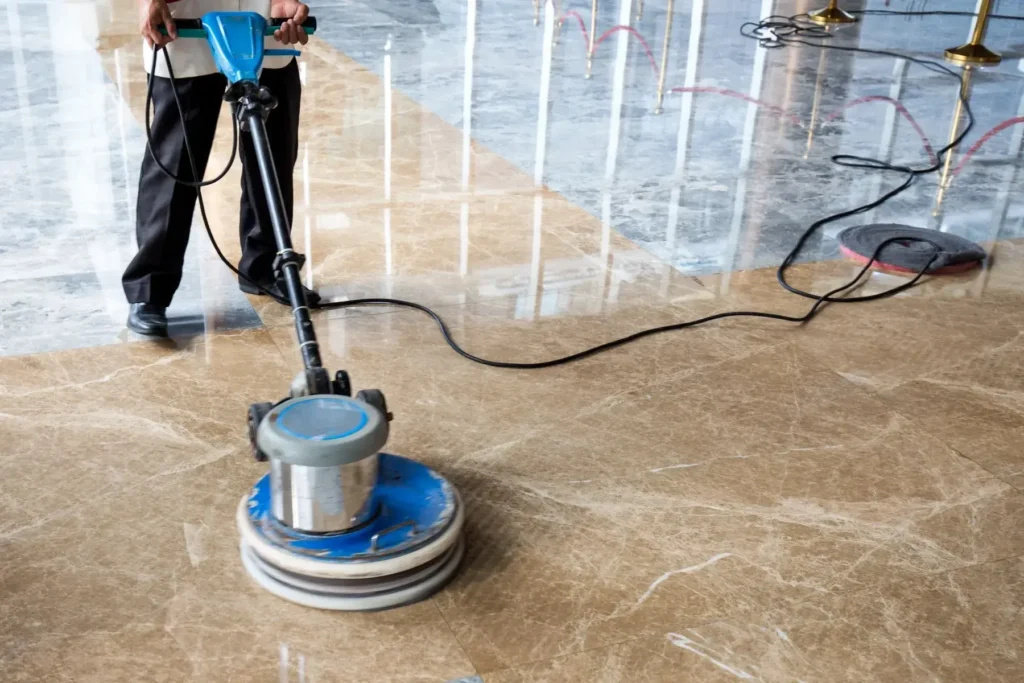
Surface profilingCoating and adhesive prepContained dust
Concrete grinding Calgary: profile and prep before the coating
Grinding here is preparation, not decoration. We open the surface of the slab to the profile the next product needs, take off laitance, old adhesive and failed coatings, and knock down the high spots that would otherwise show through.
Profile set by the coating manufacturer
Residue and old coatings removed
Dust captured at the machine
Request a Concrete Grinding Quote
Send the area, what is on the slab now and which coating or covering is going down afterwards.
Grinding shapes the surface of the slab. It does not correct a slab that is structurally moving.
The specification comes from above
The coating spec sets the concrete grinding profile
Concrete grinding is specified from above rather than by habit. Coating and adhesive manufacturers publish the surface profile and the surface condition their product requires, and that published requirement is what sets the tooling, the number of passes and how much material comes off. A thin sealer wants a very different surface from a build-coat epoxy, and a moisture-sensitive adhesive wants a different one again. We ask which product is going down before deciding how the slab gets prepared, because grinding to the wrong profile is not a small error; it is the reason coatings peel.
How concrete grinding is sequenced on a Calgary slab
1
Read the slab
Check for coatings, adhesive residue, curing compound, laitance, patches, cracks and any displacement across the floor.
2
Set the target profile
Take the required surface condition from the data sheet of the coating, adhesive or covering that is going down.
3
Grind in passes
Work through tooling from aggressive to finishing, removing residue and reducing high spots in controlled passes rather than one deep cut.
4
Clean and verify
Vacuum thoroughly, inspect the profile across the whole area and flag anything that still needs patching or levelling.
What concrete grinding can and cannot do
Grinding changes the surface of a slab and nothing below it. These are the limits that decide what has to be priced separately.
It removes surface contamination
Curing compounds, laitance, glue residue, paint, thin failed coatings and general surface weakness come off, leaving sound concrete to bond to.
It opens the pore structure
A ground surface gives a coating or adhesive somewhere mechanical to key into. A dense, closed, power-trowelled surface gives it almost nothing.
It reduces high spots
Humps, trowel ridges and lipping at cracks can be taken down, within limits. Once the aggregate or reinforcement is close to the surface, grinding deeper stops being an option.
It does not fill low areas
You cannot grind a dip out of a floor. Broad low areas are a patching or levelling job, and that gets priced separately once the grinding shows their true extent.
It does not stop slab movement
A slab that is heaving or actively cracking will keep doing so under a beautifully prepared surface. That is an assessment question, not a grinding question.
Flooring Experts Calgary carries out concrete grinding in Calgary as slab preparation, opening the surface to the profile the next coating, adhesive or floor covering requires.
What concrete grinding does to a Calgary slab surface
A trowelled concrete slab is a poor bonding surface. The finishing process brings fine material to the top and closes the pores, which leaves a hard, smooth, slightly weak skin called laitance. Coatings applied over that skin are bonded to the skin, not to the concrete, and when the skin lets go the coating goes with it.
Concrete grinding removes that layer and opens the pore structure so a coating or adhesive has somewhere mechanical to key into. It also strips off what has accumulated since: curing compound, paint, sealer, adhesive residue from a floor that was just taken up, and thin coatings that have already begun to fail.
The target is not a look. It is a stated surface condition, published by the manufacturer of whatever is going down next, and it varies significantly between products. A penetrating sealer, a build-coat epoxy and a moisture-sensitive plank adhesive each want something different from the same slab. That is why the first question is always what is going on top, and only then how the slab gets prepared.
Concrete grinding for adhesive residue, high spots and old coatings
Most Calgary concrete grinding falls into three jobs.
Adhesive residue is the most common. When tile, sheet vinyl or glued plank comes up, the covering releases long before the adhesive does, and the residue left behind is exactly what prevents the next system bonding. Hard, brittle residue grinds off cleanly. Soft cutback loads the tooling and takes considerably longer, which is why residue type is worth identifying before the job is priced.
High spots are the second. Trowel ridges, humps around a floor drain, patched areas standing proud of the surrounding slab, and lipping where one side of a crack has risen can all be reduced by grinding. There is a hard limit, though: once you are down near the coarse aggregate or getting close to reinforcement, taking off more is no longer a preparation decision. Beyond that point a high spot is a levelling problem for the surrounding area rather than a grinding problem at the hump.
Old coatings are the third. Failing epoxy, floor paint and sealers that have gone chalky or are peeling are ground off rather than recoated, because a new system bonded to a failing one inherits its failure.
Concrete grinding dust control and slab condition in Calgary
Concrete dust is not a nuisance issue, it is a health one. Respirable crystalline silica is generated by grinding, so extraction is built into the method: a vacuum matched to the grinder pulling at the head, sealed containment at doorways and openings, and a clean-up sequence that does not simply move the dust somewhere else. Dust capture is quoted as part of the grinding scope, along with the containment at doorways and the route the waste takes out of the building.
The other site-specific question in this city is what the slab is doing. Expansive, shrink-swell clay soils are widespread across Alberta including Calgary, and forensic engineering sources note that basement floor slabs are affected by clay movement far more than footings are, which is why heaved and cracked slabs turn up here much more often than genuine foundation damage. Grinding will happily take the lip off a displaced crack and make it disappear under a coating. It will not stop the displacement. If a slab has moved recently or is still moving, that gets assessed before a floor finish is ordered, because the displacement will work its way back through whatever is bonded to the prepared surface.
Concrete grinding questions in Calgary
Is concrete grinding the same thing as polished concrete?
No, and the difference matters when you are pricing. Prep grinding stops as soon as the slab is clean, open and flat enough for the specified system, and something else goes over the top. Polishing carries on through progressively finer grits so that the concrete itself becomes the finished floor.
How do you know how much to grind off?
From the data sheet of whatever is going down next. Coating and adhesive manufacturers state the surface condition they need, and that requirement drives the tooling and the number of passes. Grinding without knowing the next product is guesswork.
How much dust does grinding a slab produce?
A great deal if it is done badly and very little if it is done properly. Dust is captured at the machine head by a vacuum sized for the grinder, with containment at the openings. Silica dust is a genuine health hazard, which is why extraction is part of the method rather than an optional extra.
Can you grind out the old glue from a removed tile or vinyl floor?
Usually, yes, and it is one of the most common reasons to grind. Adhesive residue is exactly what stops a new coating or adhesive bonding. The variable is how thick and how soft the residue is, because soft cutback loads tooling quickly and slows the work down.
My garage slab is cracked and one side sits higher. Can grinding fix it?
Grinding can reduce the lip at the crack so the difference is not a trip hazard or a visible line under a coating. It does not address the cause. Expansive clay soils around Calgary move slabs, and displacement that is still active will reappear through whatever goes on top.
Does the slab need to dry before a coating goes on?
Coatings and adhesives generally specify a moisture condition for the slab as well as a profile, and that requirement has to be met before anything is applied. It is checked against the manufacturer's stated method rather than assumed from how the floor looks.
Get a concrete grinding quote in Calgary
Tell us the area, what is on the concrete now and which coating, adhesive or covering follows. We will set the preparation around that.
To provide the best experiences, we use technologies like cookies to store and/or access device information. Consenting to these technologies will allow us to process data such as browsing behaviour or unique IDs on this site. Not consenting or withdrawing consent, may adversely affect certain features and functions.
Functional
Always active
The technical storage or access is strictly necessary for the legitimate purpose of enabling the use of a specific service explicitly requested by the subscriber or user, or for the sole purpose of carrying out the transmission of a communication over an electronic communications network.
Preferences
The technical storage or access is necessary for the legitimate purpose of storing preferences that are not requested by the subscriber or user.
Statistics
The technical storage or access that is used exclusively for statistical purposes.The technical storage or access that is used exclusively for anonymous statistical purposes. Without a subpoena, voluntary compliance on the part of your Internet Service Provider, or additional records from a third party, information stored or retrieved for this purpose alone cannot usually be used to identify you.
Marketing
The technical storage or access is required to create user profiles to send advertising, or to track the user on a website or across several websites for similar marketing purposes.